Join for quick access. Enter your email below and we'll send confirmation plus sign you up to our newsletter.
By submitting your information, you confirm you are aged 16 or over,
have read our
Privacy Policy
and agree to the
Terms & Conditions. Geographical rules apply.
Stay On the Cutting Edge: Get the Tom's Hardware Newsletter
Get Tom's Hardware's best news and in-depth reviews, straight to your inbox.
You are now subscribed
Your newsletter sign-up was successful
Join the club
Get full access to premium articles, exclusive features and a growing list of member rewards.
An account already exists for this email address, please log in.
Bambu Lab officially teases its first 3D scanner — S1 3D set for launch in November 2026
Bambu Lab has officially teased its S1 3D scanner, ahead of its planned release in November 2026. No details of the product have been released yet, but FCC filings and Bambu Lab’s partnership with SCANOLOGY may hint at the scanner’s capabilities and shared technology.
3D scanners are a niche within a niche, and not necessarily within the 3D printing niche either. 3D scanning is used in many fields, like game asset creation, texture assets, archaeology, prosthetics, and museum archiving; and the rise of 3D printing has created a small but growing demand in the form of reverse engineering automotive and various niche parts. However, because of PC requirements, the intensive and technical scan cleanup, and resurfacing in CAD programs, it remains a small niche; a niche currently being served by brands such as Creality with their CR-Scan line of 3D scanners, Revopoint’s Pop series, mini, and all-in-one MIRACO scanner, and SHINING3D’s Einstar prosumer-level 3D scanner.
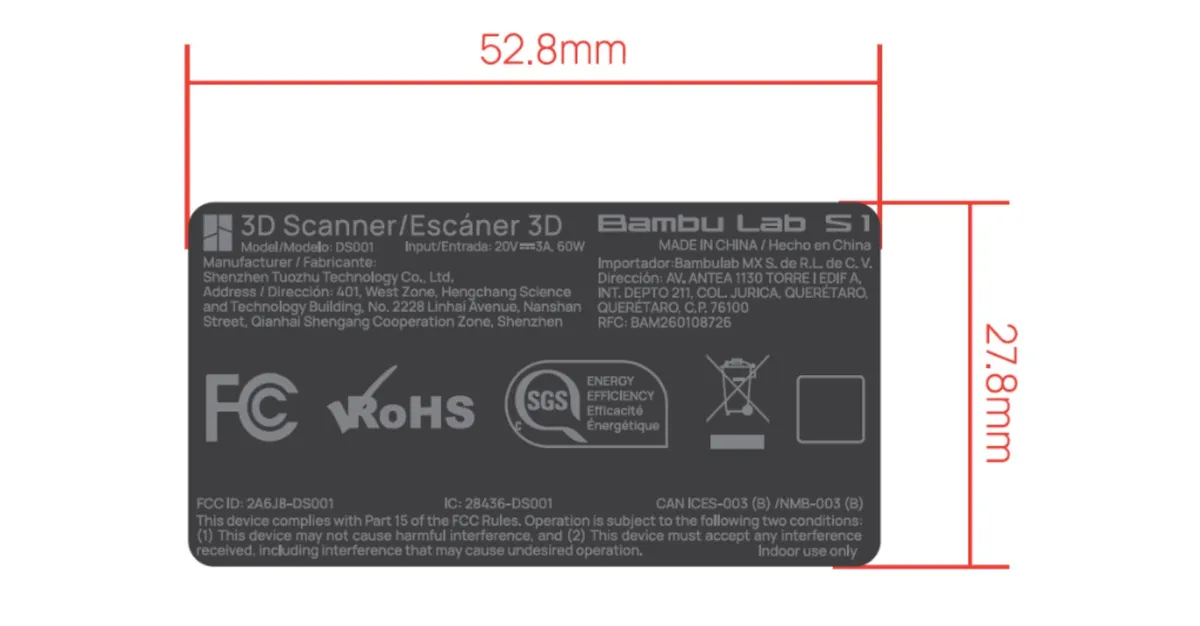
(Image credit: FCC)
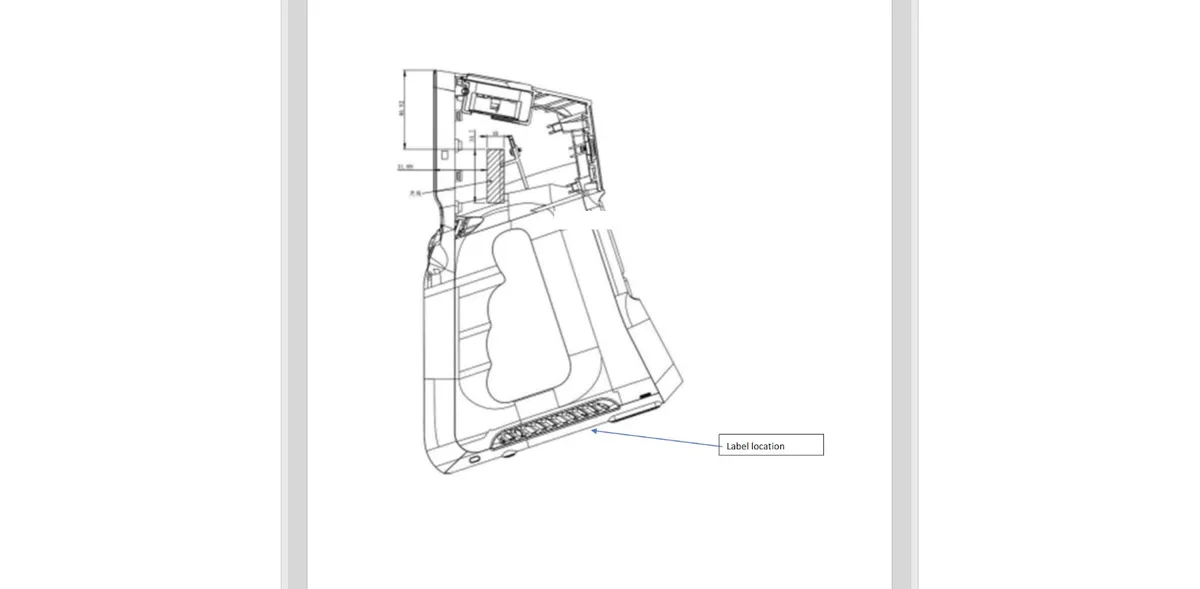
Speculations in Bambu Lab’s own forums found FCC filings for a label and drawing of the scanner. The label shows a 60W-rated input, leading some to speculate a shared platform with SCANOLOGY’s 3DeVOK MT Gen2, a wired composite 3D scanner released in 2026, using both blue and IR lasers, and also has a rated input of 60W. The input rating doesn’t necessarily confirm that they share technology, but it does give a small hint of its potential capabilities, with the number of lasers and potentially a screen dictating the power requirements.
Considering the flat spot and the top of the handle on the FCC drawings, it looks like there may be a screen, possibly like the 3DeVOK MT Gen2. More importantly, the 60W rating with no hints of a battery on the label may mean this scanner will require a PC to operate. This is often a pain point, as you would either need a powerful laptop to bring while scanning, or use a really long USB cable to your PC. As for the price, the 3DeVOK MT Gen2 is officially priced at $8,299, which is a very high price point, further making it unlikely that they may share a platform if Bambu Lab wants to keep consumer-friendly pricing.
Jhet Borja is a serial hobbyist who was taking apart toys from childhood and sketching inventions. He now loves doing DIY projects ranging from designing custom 3D-printed parts, building PCs and keyboards, all the way to woodworking. If he's not getting his hands dirty, he's probably brainstorming his next project.
Possibly could use WiFi to transfer point cloud data to the computer instead of USB. That's how some of the industrial scanning arms do it, not sure exactly why since scanning arms are stationary anyways.
It likely won't be long before your phone camera combined with AI will do the same thing if not better.
It will never be on the level of scanners. Most of the 3d models you see taken by photogrammetry only look good because they have the image texture on it. If you actually measure it, it will not be very accurate.
The same thing has been said about cell phone cameras and DSLRs.
Yes, camera phones have gotten a LOT better recently.
And they are mostly good enough for regular people use.
But DSLRs have also gotten better.
Cell phones still can't compare on a pro level.
Cell phones with current AI are already accurate to single digit millimeter level and current AI isn't even that good yet. It's advancing very rapidly though so for the bulk of 3D scanning needs it should be good enough. Specialized high end devices should always be better especially when they're also AI enhanced.