









Tom's Hardware Verdict
The Mac Studio with M5 Ultra is a small powerhouse PC with strong performance, fast memory throughput, and the ability to run AI models locally (if that's your thing).
Reasons to buy
- +
M5 Ultra delivers powerful performance
- +
1.2 TB/s memory throughput is excellent for local AI models
- +
Small, quiet design
- +
Plenty of ports
Reasons to avoid
- -
Pricey memory and SSD upgrades
- -
Not upgradeable after purchase
Why you can trust Tom's Hardware Our expert reviewers spend hours testing and comparing products and services so you can choose the best for you. Find out more about how we test.
Earlier this year, Apple discontinued the Mac Pro, leaving the Mac Studio as its top-end desktop. With the new M5 Ultra chip, Apple's relatively diminutive system is more than ready to take on the mantle.
While you might not have a ton of PCIe connections and both RAM and storage are set, the Studio offers a ton of ports for accessories, monitors, and peripherals, memory options up to 256GB (with 512GB coming later), and a clean, quiet design.
Starting with an M5 Max at $2,499, the Mac Studio could be poised as a creator system for video editors, photographers, or game designers. At $12,299 as tested with the top-end M5 Ultra, 256GB of unified memory, and 4TB of storage, it effectively becomes an enterprise device, possibly a remote server, that could handle any task with aplomb, including local AI.
Design of the Mac Studio (2026)
Apple hasn't made any changes to the Mac Studio's design. It's a silver, squared-off block that's 7.7 x 7.7 inches on your desk that stands 3.7 inches tall. The aluminum chassis has a shiny Apple logo on the top. The M5 Ultra version we tested weighs 8 pounds, a 2-pound increase over the M5 Max variant. This is largely because the M5 Max version uses a cooler with a thin aluminum stack and a copper heat pipe, while the M5 Ultra uses a heavier copper fin stack and a copper vapor chamber.


View Original

View Original

The back of the system is also home to the power button, as well as a bunch of air holes for exhausting heat.

The air comes in through more holes in a small stand built into the bottom of the system. (There's also a Kensington lock slot, though its placement on the bottom necessitates a special adapter.)

Mac Studio (2026) Specifications
Processor
|
Apple M5 Ultra (36-core CPU)
|
Graphics
|
80-core GPU (integrated)
|
Memory
|
256GB LPDDR5 unified memory
|
Storage
|
4TB SSD
|
Networking
|
Apple N1, Wi-Fi 7, Bluetooth 6, Thread
|
Front Ports
|
2x Thunderbolt 5 (USB-C), SD card reader (UHS-II)
|
Rear Ports
|
4x Thunderbolt 5 (USB-C), 2x USB-A, HDMI 2.1, 10Gb Ethernet, 3.5 mm headphone jack
|
Power Supply
|
480W maximum continuous power
|
Operating System
|
macOS 27.0 Golden Gate
|
Dimensions (WxDxH)
|
7.7 x 7.7 x 3.7 inches (9.5 x 19.7 x 19.7 mm)
|
Price as Configured
|
$12,299.00
|
Ports and Upgradeability on the Mac Studio (2026)
On the front, there are two Thunderbolt 5 (USB Type-C) ports along with an SDXC card slot. The rest of the ports are on the rear, including another four Thunderbolt 5 ports, two USB Type-A ports, HDMI 2.1, a 10Gb Ethernet jack, and a 3.5 mm headphone jack.
Get Tom's Hardware's best news and in-depth reviews, straight to your inbox.
There is no upgrading the Mac Studio. The RAM is soldered to the board, so be sure to get what you need when you're first buying the system, and Apple doesn't sell replacement SSDs (Some third parties may sell reverse-engineered NAND, but it will certainly void your warranty, and Apple doesn't support it. You're best off using external storage)
M5 Ultra
If you pony up for the most expensive Mac Studio configurations, you'll get Apple's most powerful chip. This is the only machine that Apple currently puts that chip inside.
M5 Ultra is Apple's first quad-die chip, connecting a pair of dual-die M5 Max SOCs over its UltraFusion connection. Apple claims that UltraFusion increases bandwidth between the dies to over 4.4 TB/s. Memory bandwidth is up to 1.2TB/s, which lets users store and run huge LLMs entirely on device.
Each of the 80 GPU cores features a neural accelerator, and there's a 32-core neural engine. There's now a media engine with hardware-enabled H.264, HEVC, hardware-accelerated AV1 decode, and four ProRes encode and decode engines.
Cinebench estimates that the M5 Ultra runs single-core at 4.6 GHz and multi-core at 4.3 GHz.
Productivity Performance on the Mac Studio
The Mac Studio is an absolute workhorse. The system stayed largely quiet (though the fan can make itself known) as it powered through our benchmarks. Anything you might want to do on a Mac, you can do on this one.
In fact, while we ran our basic desktop suite on this, we also ran some extra tests, as we don't test many workstations. Instead of pitting this system against other desktops, we pitted it against other workstations to get a better idea of how the M5 Ultra performs. While that's a bit antithetical to the way Apple designs its products (it doesn't sell chips separately; it designs them as part of its computers), it does give us a reference point to the chips powering the Windows and Linux workstations.

On Geekbench 7, the Mac Studio was the clear winner, with the ARM-based chip leading the pack in the bursty workload with a single-core score of 3,770 and a multi-core score of 52,293, despite having fewer cores than the competitors.

The Mac continued its lead on Handbrake, transcoding a 4K video to 1080p in 1 minute and 4 seconds. The next closest, the AMD Ryzen Threadripper 9980X, took 8 seconds longer.

On Blender's benchmark testing CPU-based rendering, the Studio with M5 Ultra fell behind the previous- and current-gen Threadrippers (7980X and 9980X, each with 64-cores), as well as the 56-core Intel Xeon w-3495X.

The Mac Studio with M5 Ultra copied 25GB of files at a rate of 2,983.08 MBps, surpassing the speeds of the M3 Ultra and M4 Max from the last generation.

The Mac Studio was consistent over our 10-run Cinebench 2026 stress test. Its lowest score, 17,825, was actually the first run. When the cooling kicked in, the rest of the results were slightly higher. The sixth run was the highest at 18,069, but it was so similar to the other runs that it's within the margin of error.
During the test, the CPU measured an average of 78.29 degrees Celsius.
Local AI on the Mac Studio (2026)
The M5 Ultra's GPU cores feature neural accelerators, granting it some extra matrix math horsepower, and Apple has boosted the chip's memory bandwidth to 1.2 TB/s, double that of the M4 Max we previously tested for AI.
The M5 Ultra's prompt processing speeds are even faster than Nvidia's DGX Spark's, and its tokens-per-second throughput is double that of the M4 Max and almost four times higher than the DGX Spark across the board.

Our tests, here using Qwen 3.8-27B-Q4_K_M, a dense model that relies heavily on memory bandwidth, are largely aimed at GPU performance in isolation. But combined with the blazing-fast single- and multi-threaded performance of the 36-core CPU, the Mac Studio with M5 Ultra looks to be ready for anything one might want to do with local or agentic AI workloads — and that's before someone tries to put it into an MLX cluster.

In addition to its raw performance, our M5 Ultra sample's 256GB of memory means you can fit very large, intelligent single models or a range of different models onto a single node. I spent time running models far larger than our tests with Hermes and LM Studio with strong performance. If you are interested in local AI, this will definitely do the job.
Gaming and Graphics on the Mac Studio (2026)
While the M5 Ultra and its 80-core GPU are more than capable of gaming, the Mac Studio isn't a gaming-first rig. For the price, systems with Nvidia's high-end graphics cards are far more competitive.
To stress the Mac Studio, I booted up InZoi, a life simulator that isn't graphically imposing but is hard on the CPU and memory. I set both the simulation performance and graphics to ultra settings, and set the game to 1080p, but allowed for upscaling with MetalFX's Performance mode, which upscaled from 960 x 540. The game ran between 45 and 65 frames per second, dropping to the lower end in outdoor environments with lots of other characters.
To compare more graphically demanding games, I picked out a few gaming PCs we've tested in the last year and pitted them against each other with the data from the Cyberpunk 2077 benchmark with the Ray Tracing Ultra preset, which we use for those kinds of rigs.
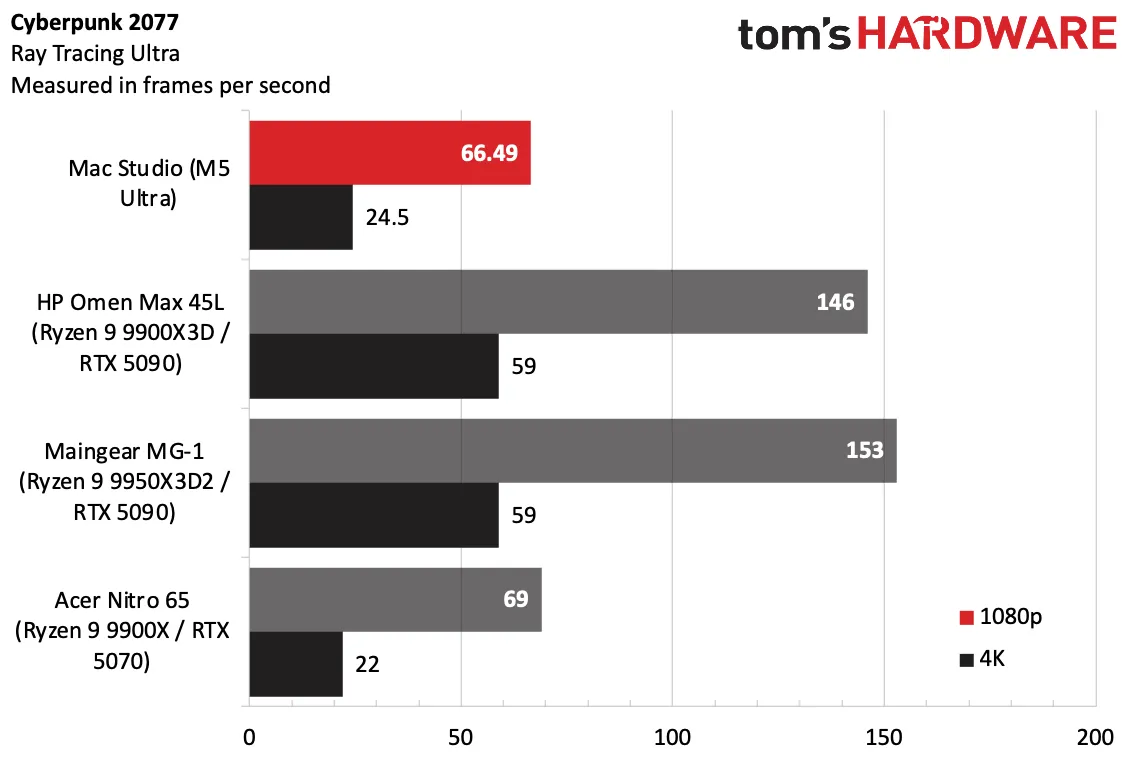
At 1080p, the Mac Studio ran the game at 66 FPS, falling behind systems like the HP Omen Max 45L and Maingear MG-1 with Nvidia's top-end GeForce RTX 5090. It was much more in line with the Acer Nitro 65, with an RTX 5070. At 4K, the Mac Studio didn't reach playable levels, though the RTX 5090 systems both reached 59 FPS.
Using Cyberpunk's "For This Mac" preset set the resolution to 1440p, turned off ray tracing, and mostly stuck to high settings and effects options.

On 3DMark's Steel Nomad graphics test, the Mac Studio still fell far behind the RTX 5090 system, but outperformed the RTX 5070-based Acer desktop.
Software and Warranty on the Mac Studio (2026)
The Mac Studio comes with macOS 27 Golden Gate. This is a great update over macOS 26 Tahoe, refining the Liquid Glass aesthetic and making it more customizable (I actually kind of like it in this iteration), and yes, thank heavens, consistent window shapes. It also adds the new Siri AI (be sure to get on the waitlist). The new Siri is far superior to the one you're used to.
Golden Gate also adds AI throughout apps, including more photo features, including a better Clean up option and spatial reframing, which lets you move a camera after you take a picture (the latter is kind of surreal). Better indexing makes it easier to search messages, emails, and calendar entries, and now you can use natural language to create automations in the Shortcuts app or come up with your own Safari extensions.
There's no bloatware, as usual. Apple's software suite includes Safari, Messages, Photos, Maps, Notes, and Reminders. Its services, including News and Apple TV, also have applications. Pages, Keynote, and Numbers are still in the dock by default, but they're the Creator Studio subscription versions, which require a subscription to get full features, including AI functionality, royalty-free graphics, and additional templates.
People using the Mac Studio as a server running AI models may not need all of those programs. For the first time in a while, I found myself wishing for something akin to macOS Server, but for better remote monitoring. I would also like to see an option for a system of this class to come with pared-down built-in apps, perhaps limiting it to the browser, App Store, Terminal, Activity Monitor, and other essentials and letting system admins decide what else needs or deserves to be there. A video editor might want to use Messages on the side. But you don't need that for a cluster running a huge model.
Apple sells the Mac Studio with a one-year warranty. Further repairs and support can be added as part of AppleCare+ ($6.49 monthly or $64.99 annually), or as part of AppleCare One or AppleCare Family.
Mac Studio (2026) Configurations
Our Mac Studio review configuration is clearly an enterprise machine. With the top-end M5 Ultra (36-core CPU, 80-core GPU), along with 256GB of RAM (currently the top-end option, with a 512GB configuration coming in late October), and a roomy 4TB SSD, it costs $12,299.00, but that's not stopping anyone: As of this writing, it's backordered between 16 and 18 weeks.
But there are a lot of steps below that. The base model is $2,499 with the M5 Max (18-core CPU, 32-core GPU), 36GB of memory, and 512GB of storage. There are two versions of each: the M5 Max and M5 Ultra. Going from a 32-core GPU to a 40-core GPU on the M5 Max costs $300.
The cheapest M5 Ultra system is $5,499 with a 30-core CPU and 64-core GPU, along with 96GB of memory and 1TB of SSD storage. Bumping up to the M5 Ultra we tested increases the price by $1,300. Moving from 96GB of RAM to 256GB adds $4,000. Bumping up from a 1TB SSD to 2TB is $500, while our 4TB SSD is a $1,500 increase.
The M5 Max configurations have slight port differences on the front of the desktop. The USB-C ports on those are 10Gb/s ports, while on the M5 Ultra, you get Thunderbolt 5 for up to 120Gb/s.
Bottom Line
At $12,299, the Mac Studio with M5 Ultra is effectively an enterprise computer, capable of difficult workloads like rendering and running AI models that are as close to frontier-grade as you're going to get right now on edge computing.

Much of that price also comes from RAM and storage. Given the fact that you can't really upgrade this computer, businesses and people using this for their job may see the extra cost as an investment. Really, its biggest weakness is in gaming, for professionals who may want to do that on the side. Discrete GPUs still win there.
Given the fact that an AMD Ryzen Threadripper 9980X, a 64-core monster that beats this CPU in Blender, is priced around $5,000 on its own before memory, storage, power supplies, or any other components, it may not actually be that crazy in this market, and the Mac Studio can be had in a much smaller case. (For wealthy homelabbers, businesses, and server farms, third-party accessory makers already make rack mounts to fit the Mac Studio; its shape hasn't changed since its last redesign).
For local AI, the M5 Ultra is seriously impressive, though that may still be a niche use case for some. But in a computer that can reach over $12,000, niche is the name of the game.
This all makes the M5 Ultra version of the Mac Studio an impressive package and further proof of the power and performance Apple can draw out of its own silicon in concert with its own software.

Andrew E. Freedman is a senior editor at Tom's Hardware focusing on laptops, desktops and gaming. He also keeps up with the latest news. A lover of all things gaming and tech, his previous work has shown up in Tom's Guide, Laptop Mag, Kotaku, PCMag and Complex, among others. Follow him on Threads @FreedmanAE and BlueSky @andrewfreedman.net. You can send him tips on Signal: andrewfreedman.01
-
LordVile Reply
There is a native ARM version however I’m not sure on apples RT performance which was a strange setting to turn on. I’m also assuming it’s using upscaling on the windows machines based on the 5090Pierce2623 said:Was CP2077 run through a translation layer or is there an ARM native version? -
Bebydis Yay, good showing. But it is too expensive, we are reacing 1990s prices. 3d performance is still worse than a 5 year old amd 6900xt card. Not bad at all, but how much is the bad design decisions in macos holding rhe hardware back? The ipc is still a huge bottleneck, but apple utterly outperforms ntfs with the newer Dominic Giampalo designs.Reply -
DS426 Not even limited to proprietary or limited upgrades but purely non-upgradable!?... nahhhhh. Might as well shape it like the trash can Macs, lol.Reply -
artk2219 Reply
Ironically the trashcan macs WERE upgradable, even if they are a pain to work on. Unfortunately that is not the case with this expensive and put out to pasture before its time future ewaste :-/ . Sadly that seems to be the trend nowadays, lack of serviceability is now unfortunately a common theme from phones to cars to farm equipment.DS426 said:Not even limited to proprietary or limited upgrades but purely non-upgradable!?... nahhhhh. Might as well shape it like the trash can Macs, lol. -
artk2219 Reply
Nope, thats native on a 5090, but its a 5090 and costs like 6 grand on its own currently. Its not a terrible showing if you don't take price into account, its around RTX 5070 \ RX 9070 territory. Intel still doesn't have a card with that sort of performance available yet.LordVile said:There is a native ARM version however I’m not sure on apples RT performance which was a strange setting to turn on. I’m also assuming it’s using upscaling on the windows machines based on the 5090
https://www.techpowerup.com/review/pny-rtx-5080-slim-oc/33.html
https://tpucdn.com/review/pny-rtx-5080-slim-oc/images/rt-cyberpunk-2077-1920-1080.png
https://cdn.mos.cms.futurecdn.net/2R8VeJcDuDaZSLNPebdWzV-970-80.png.webp
Arc B70 -
LordVile Reply
Techspot has the 5090 lower. Your first chart also doesn’t include what settings they’re onartk2219 said:Nope, thats native on a 5090, but its a 5090 and costs like 6 grand on its own currently. Its not a terrible showing if you don't take price into account, its around RTX 5070 \ RX 9070 territory. Intel still doesn't have a card with that sort of performance available yet.
https://www.techpowerup.com/review/pny-rtx-5080-slim-oc/33.html
https://tpucdn.com/review/pny-rtx-5080-slim-oc/images/rt-cyberpunk-2077-1920-1080.png
https://cdn.mos.cms.futurecdn.net/2R8VeJcDuDaZSLNPebdWzV-970-80.png.webp
Arc B70 -
artk2219 Reply
That is why i included the link for the article above the picture. Though they're not all going to be the same results, different setups and such, regardless, the performance stated out of the 5090 in the review is not strange, it really is just that beefy.LordVile said:Techspot has the 5090 lower. Your first chart also doesn’t include what settings they’re on
https://www.techpowerup.com/review/pny-rtx-5080-slim-oc/4.html
Test SystemTest System - GPU 2025.2Processor:Motherboard:Resizable BAR:Memory:Cooling:Thermal Paste:Storage:Power Supply:Case:Operating System:Drivers:
AMD Ryzen 7 9800X3DZen 5, 5.2 GHz, 8 cores/16 threads
MSI X870E Carbon Wi-FiBIOS 7E49v1A3
Enabled on all supported cards
(NVIDIA, AMD & Intel)
Thermaltake TOUGHRAM XG2× 16 GB DDR5-6200 28-36-36-76 UCLK 1:1
Arctic Liquid Freezer III280 mm AIO
Arctic MX-64 TB M.2 NVMe SSD
Seasonic Focus GX 1000 WATX 3.0 / 16-pin 12VHPWR
darkFlash DY470Windows 11 Professional 64-bit 24H2
VBS enabled (Windows 11 default)
RX 9060 XT, RX 9070 & RX 9070 XT: 25.11.1 WHQL
Other AMD cards: 25.3.2 Beta
NVIDIA RTX 50 cards: 581.15 WHQL
RTX 5050: 576.88 WHQL
Other NVIDIA cards: 572.83 WHQL
Intel: 101.6732 Beta
Date of Retest
Benchmark scores in other reviews are only comparable when this exact same configuration is used.
All games and cards are tested with the drivers listed above—no performance results were recycled between test systems. Only this exact system with exactly the same configuration is used for all results in this review.
All graphics cards are tested using the same game version.
All games are set to their highest quality setting unless indicated otherwise.
All games are running at their native resolution without upscaling (no DLSS or FSR), except for the results on the "DLSS 4" page where we specifically look into that feature's performance.
All games have ray tracing disabled, except for testing on the "Ray Tracing" and "Path Tracing" pages.
AA and AF are applied via in-game settings, not via the driver's control panel.
Before starting measurements, we heat up the card for each test to ensure a steady state is tested. This ensures that the card won't boost to unrealistically high clocks for only a few seconds until it heats up, as that doesn't represent prolonged gameplay.
For better real-life applicability, all game tests use custom in-game test scenes, not the integrated benchmarks.
All cards used for comparison are reference designs. When a reference design does not exist, we go the extra mile and buy the closest possible match, which has reference clocks and default power limit.Each game is tested at these screen resolutions:
1920×1080: Most popular monitor resolution.
2560×1440: Intermediary resolution between Full HD and 4K, with reasonable performance requirements.
3840×2160: 4K Ultra HD resolution, available on high-end monitors.Date of RetestWe retest all our comparison cards every few months, with the latest drivers, new games, patches and OS updates.
2025-04-01: Arc A770 16 GB
2025-04-01: Arc B580 16 GB
2025-04-01: RTX 3060 12 GB
2025-04-02: RTX 3070 8 GB
2025-04-02: RTX 3080 10 GB
2025-04-02: RTX 3090 Ti 24 GB
2025-04-03: RTX 4060 8 GB
2025-04-03: RTX 4060 Ti 8 GB
2025-04-03: RTX 4060 Ti 16 GB
2025-04-04: RTX 4070 12 GB
2025-04-04: RTX 4070 Super 12 GB
2025-04-04: RTX 4070 Ti 12 GB
2025-04-05: RTX 4070 Ti Super 16 GB
2025-04-05: RTX 4080 16 GB
2025-04-05: RTX 4080 Super 16 GB
2025-04-05: RTX 4090 24 GB
2025-08-20: RTX 5060 8 GB
2025-08-19: RTX 5060 Ti 8 GB
2025-08-19: RTX 5060 Ti 16 GB
2025-08-18: RTX 5070 12 GB
2025-08-18: RTX 5070 Ti 16 GB
2025-08-17: RTX 5080 16 GB
2025-08-17: RTX 5090 32 GB
2025-04-07: RX 6800 XT 16 GB
2025-04-07: RX 6900 XT 16 GB
2025-04-08: RX 7600 8 GB
2025-04-08: RX 7600 XT 16 GB
2025-04-08: RX 7700 XT 12 GB
2025-04-09: RX 7800 XT 16 GB
2025-04-09: RX 7900 GRE 16 GB
2025-04-09: RX 7900 XT 20 GB
2025-04-09: RX 7900 XTX 24 GB
2025-11-17: RX 9060 XT 8 GB
2025-11-17: RX 9060 XT 16 GB
2025-11-18: RX 9070 16 GB
2025-11-18: RX 9070 XT 16 GB -
LordVile Reply
Cyberpunks highest quality setting enables DLSS in quality mode. They likely missed it. Techspots results were 152FPS with RT and DLSS enabled. Turning off RT and disabling DLSS put it to over 200 at 1440p. Thats with. near identical system that should be within 5%. So they’re using RT numbers with DLSS set to quality as per the default settings. If they say they’re not then it’s likely they’ve missed the fact that it’s on be default.artk2219 said:That is why i included the link for the article above the picture. Though they're not all going to be the same results, different setups and such, regardless, the performance stated out of the 5090 in the review is not strange, it really is just that beefy.
https://www.techpowerup.com/review/pny-rtx-5080-slim-oc/4.html
Test SystemTest System - GPU 2025.2Processor:Motherboard:Resizable BAR:Memory:Cooling:Thermal Paste:Storage:Power Supply:Case:Operating System:Drivers:
AMD Ryzen 7 9800X3DZen 5, 5.2 GHz, 8 cores/16 threads
MSI X870E Carbon Wi-FiBIOS 7E49v1A3
Enabled on all supported cards
(NVIDIA, AMD & Intel)
Thermaltake TOUGHRAM XG2× 16 GB DDR5-6200 28-36-36-76 UCLK 1:1
Arctic Liquid Freezer III280 mm AIO
Arctic MX-64 TB M.2 NVMe SSD
Seasonic Focus GX 1000 WATX 3.0 / 16-pin 12VHPWR
darkFlash DY470Windows 11 Professional 64-bit 24H2
VBS enabled (Windows 11 default)
RX 9060 XT, RX 9070 & RX 9070 XT: 25.11.1 WHQL
Other AMD cards: 25.3.2 Beta
NVIDIA RTX 50 cards: 581.15 WHQL
RTX 5050: 576.88 WHQL
Other NVIDIA cards: 572.83 WHQL
Intel: 101.6732 Beta
Date of Retest
Benchmark scores in other reviews are only comparable when this exact same configuration is used.
All games and cards are tested with the drivers listed above—no performance results were recycled between test systems. Only this exact system with exactly the same configuration is used for all results in this review.
All graphics cards are tested using the same game version.
All games are set to their highest quality setting unless indicated otherwise.
All games are running at their native resolution without upscaling (no DLSS or FSR), except for the results on the "DLSS 4" page where we specifically look into that feature's performance.
All games have ray tracing disabled, except for testing on the "Ray Tracing" and "Path Tracing" pages.
AA and AF are applied via in-game settings, not via the driver's control panel.
Before starting measurements, we heat up the card for each test to ensure a steady state is tested. This ensures that the card won't boost to unrealistically high clocks for only a few seconds until it heats up, as that doesn't represent prolonged gameplay.
For better real-life applicability, all game tests use custom in-game test scenes, not the integrated benchmarks.
All cards used for comparison are reference designs. When a reference design does not exist, we go the extra mile and buy the closest possible match, which has reference clocks and default power limit.Each game is tested at these screen resolutions:
1920×1080: Most popular monitor resolution.
2560×1440: Intermediary resolution between Full HD and 4K, with reasonable performance requirements.
3840×2160: 4K Ultra HD resolution, available on high-end monitors.Date of RetestWe retest all our comparison cards every few months, with the latest drivers, new games, patches and OS updates.
2025-04-01: Arc A770 16 GB
2025-04-01: Arc B580 16 GB
2025-04-01: RTX 3060 12 GB
2025-04-02: RTX 3070 8 GB
2025-04-02: RTX 3080 10 GB
2025-04-02: RTX 3090 Ti 24 GB
2025-04-03: RTX 4060 8 GB
2025-04-03: RTX 4060 Ti 8 GB
2025-04-03: RTX 4060 Ti 16 GB
2025-04-04: RTX 4070 12 GB
2025-04-04: RTX 4070 Super 12 GB
2025-04-04: RTX 4070 Ti 12 GB
2025-04-05: RTX 4070 Ti Super 16 GB
2025-04-05: RTX 4080 16 GB
2025-04-05: RTX 4080 Super 16 GB
2025-04-05: RTX 4090 24 GB
2025-08-20: RTX 5060 8 GB
2025-08-19: RTX 5060 Ti 8 GB
2025-08-19: RTX 5060 Ti 16 GB
2025-08-18: RTX 5070 12 GB
2025-08-18: RTX 5070 Ti 16 GB
2025-08-17: RTX 5080 16 GB
2025-08-17: RTX 5090 32 GB
2025-04-07: RX 6800 XT 16 GB
2025-04-07: RX 6900 XT 16 GB
2025-04-08: RX 7600 8 GB
2025-04-08: RX 7600 XT 16 GB
2025-04-08: RX 7700 XT 12 GB
2025-04-09: RX 7800 XT 16 GB
2025-04-09: RX 7900 GRE 16 GB
2025-04-09: RX 7900 XT 20 GB
2025-04-09: RX 7900 XTX 24 GB
2025-11-17: RX 9060 XT 8 GB
2025-11-17: RX 9060 XT 16 GB
2025-11-18: RX 9070 16 GB
2025-11-18: RX 9070 XT 16 GB -
salgado18 Reply
Not that I want to defend Apple (I really don't), but to be fair, they only managed to get all that RAM bandwidth because memory is tightly integrated. There's no DDR or GDDR tech that can match those numbers.artk2219 said:Ironically the trashcan macs WERE upgradable, even if they are a pain to work on. Unfortunately that is not the case with this expensive and put out to pasture before its time future ewaste :-/ . Sadly that seems to be the trend nowadays, lack of serviceability is now unfortunately a common theme from phones to cars to farm equipment.
That said, my prediction is that this is the future of PCs: large RAM pools with big bandwith numbers. AI is going nowhere, and will go local as soon as software integrates and hardware makes it viable on high-end (not niche like Mac Studio or DGX, but top-end desktop Intel or AMD platforms).