









AMD's A620 Chipset Quietly Arrives Without Default Support for 65W-Plus CPUs
Pricing looks mostly higher than expected, too.
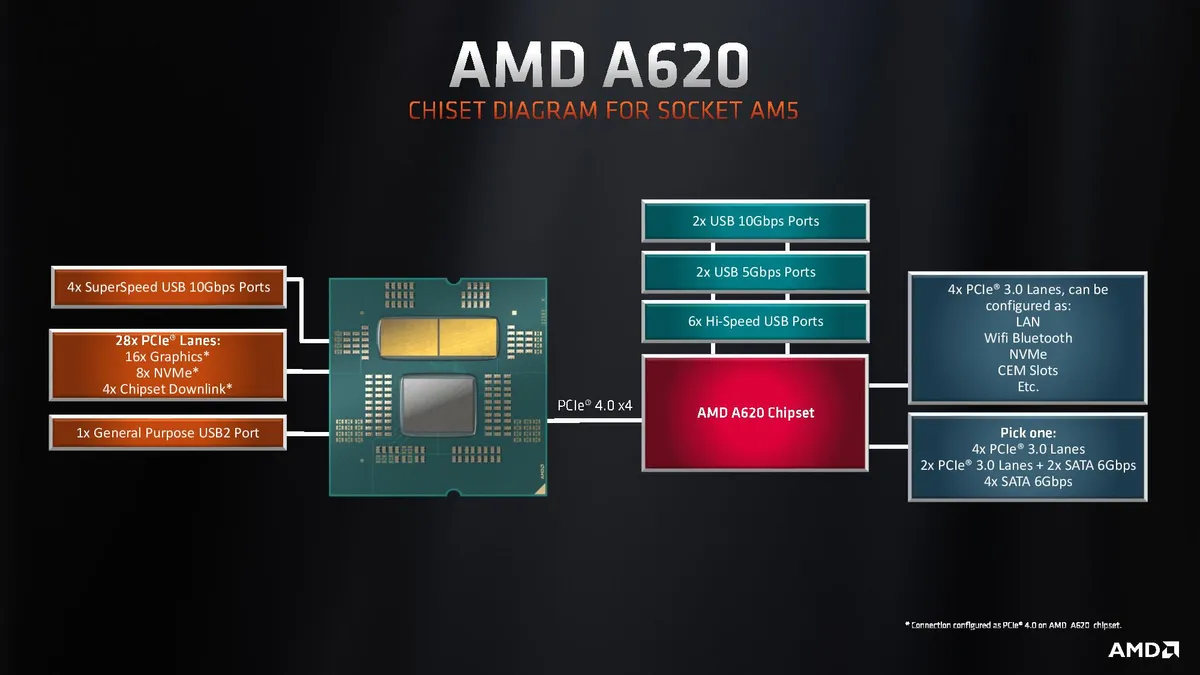
AMD has curiously taken a decidedly low-key approach to launching its value-centric A620 motherboards, burying the news of its A620 announcement late on a Friday night, but the company has finally shared the full details and slide deck with us about its new range of value-geared motherboards. To reduce pricing, the motherboards will not support the full range of Ryzen 7000 processors at their full power levels by default — none of the Ryzen 7000 X-series processors are guaranteed to be fully supported by default. These boards also eliminate some features of the more expensive AM5 motherboards, like overclocking and faster USB connectivity, in exchange for a lower price point.
Even though AMD's Ryzen 7000 lineup currently tops our list of the best CPUs for gaming, the supporting AM5 motherboard platform and required DDR5 memory have earned a reputation for egregiously high pricing. AMD even recently ran a promotion that gave you up to $125 off if you purchased a chip, motherboard, and memory, but that has expired today.
That makes for a well-timed release of AMD's budget A620 platform with at least one motherboard that will retail for $85, but early indications point to pricing exceeding $100 for several new boards. Unfortunately, that means the overall A620 lineup will likely also be more expensive than expected.
We don't have US pricing for most of the A620 motherboards, but while ASRock has one board for $85 and another for $99, ASUS announced EU pricing for three of its motherboards, with conversion to USD netting pricing of $151, $161, and $183. That's above what we expect for budget-class boards with reduced feature sets. We'll follow up with more US pricing as we receive it, but it seems there will only be a few truly budget-class boards with this generation of the A-series motherboards.


View Original

View Original

View Original

View Original

View Original

View Original

View Original

View Original

View Original

View Original

AMD's B-series motherboards are designed to support every Ryzen 7000 model at its full TDP range, sometimes resulting in seemingly ridiculously overpowered boards for the lower-end chips. This results in superior performance and forward compatibility, but also high pricing for B-series motherboards compared to Intel's competing chipsets. In contrast, Intel doesn't require its B-series motherboards to support the full peak power limits of its more power-hungry high-end chips, so vendors can cut back on power delivery (VRMs, etc.) to reduce pricing. Naturally, this results in reduced performance with the highest-end Intel chips on its budget boards.
AMD is now taking a similar approach with AM5. The A620 motherboards are designed to support chips with a 65W TDP, meaning models with a peak power consumption of 88W (PPT). Motherboard makers have the option to make more expensive models with support for higher power levels, but at its base, the A620 spec allows for a peak of 88W of power delivery.
For those base models, you can install chips with higher TDP ratings into an A620 motherboard, and it will boot if the BIOS supports it, but the chip will not operate at its full peak power consumption (PPT). This means the highest-end chips will lose some performance in heavily-threaded applications due to VRM limitations on some boards, but AMD expects the reduced power delivery will not impact gaming much.
In either case, this means that most bargain-basement A620 motherboards will only fully support non-X Ryzen 7000 models, as even the X-series Ryzen 5 chips all come with a 105W TDP. Not only do the boards not even support the base 105W TDP for the lowest-end Ryzen 5 X-series chips, but the 142W peak (PPT) is also 20% higher than the supported peak 88W PPT. That's a significant 76W delta.
This approach falls outside AMD's standard AM5 policy thus far, but it mostly makes sense. Higher-end chips aren't a good fit for this class of lower-end motherboards, and the lower power delivery will ultimately reduce pricing for budget builds. Users can choose to step up to higher-end A620 models if they want support for an X-series chip to run at its full TDP.
Additionally, this is the same approach that Intel uses for its lower-end fare. However, the fact that the X-series Ryzen chips all start at 105W means that the lowest-end A-series boards are significantly limited in their appeal.
| Header Cell - Column 0 | 65W TDP | 105W TDP | 120W TDP (X3D) | 170W TDP |
|---|---|---|---|---|
| Socket Power (PPT) Watts | 88W | 142W | 162W | 230W |
| Peak Current (EDC) Amps | 150A | 170A | 180A | 225A |
| Sustained Current (TDC) Amps | 75A | 110A | 120A | 160A |
Overall, the new motherboards will fall into a lower price range than their B-series counterparts, but as you can see in the full slide deck we've included above, there are other sensible tradeoffs in features, with the boards stepping back from B650's one USB 20Gbps and six 10Gbps ports to two USB 10Gbps and two 5Gbps ports.
A620 provides a x16 PCIe 4.0 connection but doesn't allow that to operate in a 2x8 mode like B650. A620 also supports a direct-to-CPU x4 PCIe 4.0 connection for an M.2 SSD port, but doesn't have the option for a PCIe 5.0 M.2 port like B650. This is a nice step up from the x16 PCIe 3.0 supported on the previous-gen A520, though.
Of course, many bargain-basement A620 boards will only have one M.2 slot, but A620 has the same support for four SATA ports as B650. That's also two more SATA ports than the previous-gen A520 chipset.
| Header Cell - Column 0 | A620 | A520 | B650 |
|---|---|---|---|
| CPU Graphics Support | 1x16 PCIe 4.0 | 1x16 PCIe 3.0 | 1x16 or 2x8 PCIe 4.0 |
| CPU Storage Support | 1x4 PCIe 4.0 | PCIe 3.0 | 1x4 PCIe 4.0 / 5.0 |
| CPU Chipset Uplink | 1x4 PCIe 4.0 | 1x4 PCIe 3.0 | 1x4 PCIe 4.0 |
| Overclocking Support | No | No | Yes |
| Full TDP CPU Support | 65W | Up to170W | Up to 170W |
As before, the A620 chipset doesn't support manual overclocking, so changing voltages and frequencies or auto-clocking via Precision Boost Overdrive (PBO) is off-limits. Unsanctioned BCLK overclocking was possible on at least one A520 board, but for now, it's anyone's guess if that will be possible with A620. The A620 motherboards support memory overclocking via EXPO profiles up to DDR5-6000, but we're unsure if manual memory tuning is allowed.
From what we've gleaned, these motherboards use the Prominitory 21 (PROM21) chipset, the same silicon used for AMD's X670 and B650 motherboards. The AM5 platform leverages a new chiplet-based approach for its chipsets, sometimes using two PROM21 chips for higher-end chipsets, but A620 will only include one chip. Surprisingly, AMD didn't develop lower-end chipset silicon for these budget boards, but re-use helps reduce design costs. It can also deliver cost benefits from higher-volume production. We have seen signs of a PROM22 chip that will come later, but with the same features as PROM21.
Motherboards are coming from all of the usual suspects, including ASRock, ASUS, Gigabyte, MSI, and Biostar, but US pricing hasn't been announced for all of the A620 boards yet. We'll follow up with more details as they become available.
Get Tom's Hardware's best news and in-depth reviews, straight to your inbox.

Paul Alcorn is the Editor-in-Chief for Tom's Hardware US. He also writes news and reviews on CPUs, storage, and enterprise hardware.
-
atomicWAR Can't tell if that an April Fools joke or legit reporting with 65 watt only cpus. I assume legit but their is still some knawing thoughts otherwise.Reply -
PlaneInTheSky ReplyThe motherboards will not support the full range of Ryzen 7000 processors at their full power levels. You can install chips with higher TDP ratings into an A620 motherboard, and it will boot if the BIOS supports it, but the chip will not operate at its full peak power consumption (PPT). This means the highest-end chips will lose some performance in heavily-threaded applications due to VRM limitations.
I already guessed as much by looking at these horribly cut down A620 boards, the VRM look completely inadequate to support higher-end CPU, let alone any future CPU.
A620 boards should cost $40 max. They have a PCIe 3.0 chip lane, lack in features, and have horribly cut down VRM that will severely bottleneck every CPU over 65watt.
AMD expects the reduced power delivery will not impact gaming much.
It will not impact gaming much? That's your excuse AMD?
What a bunch of baloney. You literally sold AM5 as a future proof platform and you're releasing overpriced chipsets and boards that are so cut down they bottleneck current CPU and will bottleneck every future CPU. -
thisisaname ReplyUnfortunately, that means the overall A620 lineup will likely also be more expensive than expected.
You could replace A620 with nearly any computer part and it would be true. -
bjnmail I wish AMD would allow Curve Optimizer negative offsets on Ax20 boards. We don't need PBO in its full form, but Curve Optimizer negative offsets should be available across the range, as it can really be helpful for improving efficiency.Reply
Otherwise, I think the compromises made are pretty reasonable. And the 65W TDP recommendation is actually nice to see, especially when I've had clients trying to get me to put a 5950x in an A520 with a terrible 4+2 VRM on more than one occasion before, so having the recommended TDP limited to 65W will be helpful for consumers. It's also nice that it's not a hard limit, so if you really want to torture the VRMs to a premature death with a 7950x in the cheapest A620 you can find, you can still do it if you really want to. -
Alvar "Miles" Udell The thing is though, would you really recommend someone use it? With a 65w limit you're limited to the 7600, 7700, and 7900 (Non X) , all which have lower performance than the 5800X3D in games, and while it may be 30% slower in rendering tasks, it's not really the market for the ultra budget end. And for office tasks, go with cheaper Zen 3.Reply
-
btmedic04 I fail to see how Asus deciding to gouge customers is an AMD problem. The success of Asus has gotten to their heads and hence, they've overpriced everything they make this current generation.Reply -
PlaneInTheSky ReplyI fail to see how this is an AMD problem.
It's an AMD problem because AMD flat out lied about AM5 in their slides.
AMD said "$125 motherboards" would "grow with you" and would last "through 2025+".
In reality, these $125 motherboards have a cut down chipset and cut down VRM that doesn't even support today's X or X3D series CPU, let alone those from 2025+.
When people buy a $125 motherboard, only to realise it doesn't support X or X3D CPU and they can't upgrade, they're not going to be happy. The whole selling point of AM5 was that it would "grow with you". But AMD forgot to tell anyone that you need a $250+ motherboard to do that. AMD plastered the "$125 motherboard" on their slides that in reality won't "grow with you" instead.
AMD writes right under the "$125 motherboard" sentence that you could "grow to PCIe 5.0", implying you could use existing PCIe 4.0 hardware and then upgrade it to 5.0 hardware. But the $125A620 mobo don't support PCIe 5.0, they feature PCIe 4.0 and only use PCIe 3.0 for the chipset lanes. There is no "growing into PCIe 5.0", these boards flat out don't support PCIe 5.0.
https://i.postimg.cc/xT9yhmHc/Sas-titre.png -
TechieTwo ReplyPlaneInTheSky said:It's an AMD problem because AMD flat out lied about AM5 in their slides.
AMD said "$125 motherboards" would "grow with you" and would last "through 2025+".
In reality, these $125 motherboards have a cut down chipset and cut down VRM that doesn't even support today's X or X3D series CPU, let alone those from 2025+.
When people buy a $125 motherboard, only to realise it doesn't support X or X3D CPU and they can't upgrade, they're not going to be happy.
AMD writes right under the "$125 motherboard" sentence that you could "grow to PCIe 5.0", implying you could use existing PCIe 4.0 hardware and then upgrade it to 5.0 hardware. But the $125 B620 mobo don't support PCIe 5.0, they feature PCIe 4.0 and only use PCIe 3.0 for the chipset lanes. There is no "growing into PCIe 5.0", these boards flat out don't support PCIe 5.0.
https://i.postimg.cc/xT9yhmHc/Sas-titre.png
AMD did not lie. The AM5 system has all levels of entry from a ridiculously inexpensive $85 mobo from Asrock to a $1000 price gouging mobo from Asus. Most people moving to AM5 understand it is a new platform with new DDR5 DRAM that is more expensive than DDR4. No one purchasing the cheapest entree level mobo @$85 should expect to have PCIe 5. It's of minute value now anyways. If you don't want the AM5 platform or can't afford it then the AM4 is still a viable platform that will be totally useful for many years for many people.
If there is someone to be upset with it is Asus and other mobo makers charging >$500 for a $300 mobo. AMD doesn't set the mobo nor DRAM prices. You may have noticed DDR5 prices have dropped considerably with a world wide economic recession. If you are paying more than $300 for a quality AM5 mobo you are being exploited IMNHO - but it's a choice that YOU are making. No one is being forced to buy an over-priced AM5 mobo. You can get all the whistles and bells for $300 or less on the Asrock Steel Legend X670 chipset mobo. Newegg and other suppliers also offer package discounts on mobos/CPUs or mobo/DRAM or all three. -
PlaneInTheSky ReplyMost people moving to AM5 understand it is a new platform with new DDR5 DRAM that is more expensive than DDR4.
That's right.
But how many understand that the $125 board they just bought has a cut down VRM and chipset and they either won't be able to upgrade to X or X3D CPU at all, or will be severely bottlenecked by their board.
That $80-$180 A620 range is the price range the average user spends on their board. All those people are going to think they can upgrade to higher end CPU at some point, that has been the whole selling point of AM5. They will not be able to.
AMD needs to come out with a statement that makes it clear these $80-$180 A620 boards do not properly support X and X3D. Because they sold the whole AM5 platform on upgradability. -
Unolocogringo I look at it this way. Prices are what they are, there are no more $49/$59 dollar motherboards anymore. They have to have some profit or why produce it.Reply
As long as the motherboards are labeled correctly, stating up to 65watt cpu support who cares.
You knew the limit when you purchased it.
I mean the cheapest motherboards never supported the fastest CPUs properly. It might officially run it but at slower speeds.
What is the big fuss about?
:??: