









Intel's Arc GPU Roadmap Leaked: Two Battlemage GPUs Coming in 2024
Intel preps BMG-G10 and BMG-G21 graphics processors.

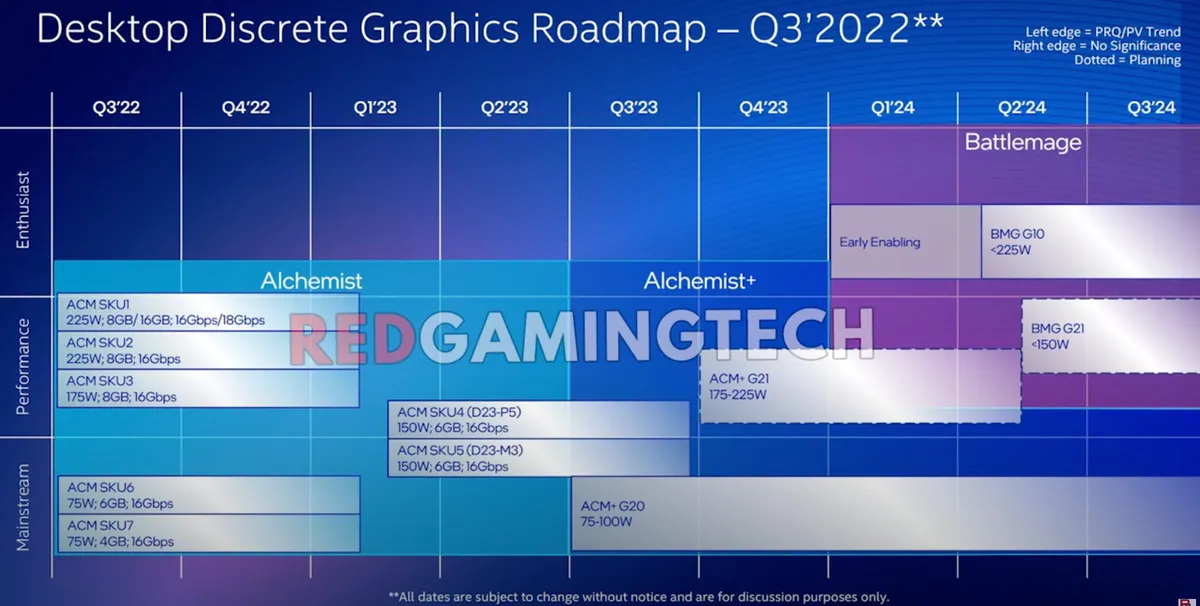
Two newly published slides allegedly reveal possible Intel Arc desktop GPU roadmap through Q3 2024 and the company's plans regarding its codenamed Battlemage family of graphics processors. If the slides published by RedGamingTech are correct, then Intel's family of desktop graphics processors based on its next generation Xe2-HPG microarchitecture will include two units designed to offer different levels of performance.
Intel's Arc Battlemage family of desktop graphics processors featuring the company's Xe2-HPG microarchitecture will resemble the company's Alchemist lineup. It will still contain two GPUs — the BMG-G10 and the BMG-G21 — targeting <225W and <150W power envelopes, but this time around Intel will go after the enthusiast-grade market segment as well. According to the slides, Team Blue plans to roll out its higher-end BMG-G10 graphics processor in Q2 2024 and follow up with its performance mainstream BMG-G21 GPU later in the quarter. Both are expected to rank among the best graphics cards.
Power targets for Intel's Arc Battlemage GPUs correspond with Intel's recently revealed plans to build GPUs for relatively low-power yet fast graphics cards rather than target the ultra-high-end market segments occupied by AMD and Nvidia. Yet, we are speculating.
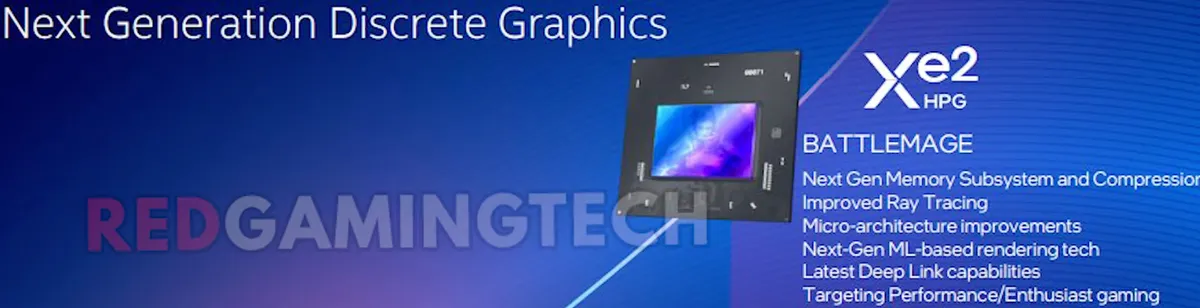
In a bid to address enthusiast and performance market segments, Intel will significantly revamp its Xe2-HPG microarchitecture. From what we can gather, the new microarchitecture will offer improved ray tracing performance, a next generation memory subsystem supporting new compression technologies, and new machine learning rendering technology. The description on the slide is vague to say the least, but since we are a year away from Xe2-HPG and Arc Battlemage, this is expected.
The slides published by RedGamingTech cover Intel's plans through the third quarter of 2024, though they are dated Q3 2022, which means that they are pretty ancient at this point as plans tend to change rapidly. In fact, we cannot even verify authenticity of the slides, so they should be taken with a grain of salt anyway. Q3 2022 means these likely predate the actual U.S. launch of the various Arc Alchemist graphics cards, and a lot of things have likely changed in the past six months.
One thing that looks rather odd is that Intel apparently plans (or at least planned) to refresh its Arc Alchemist lineup with new "Alchemist+" ACM+ G20 and ACM+ G21 graphics processors in the second half of 2023. This doesn't make a lot of sense as in H2 both AMD and Nvidia will likely introduce their next-generation entry-level and mainstream GPUs that will leave Intel's Arc Alchemist offerings behind, and investing a lot of money in a refreshed Alchemist+ lineup might be a losing proposition. Instead, engineering and other resources could be used to bring Battlemage forward — and that may have already happened in the ensuing months.
Furthermore, companies tend introduce refreshed offerings that either noticeably improve performance or are based on re-spun versions of GPUs that offer higher yields and/or improved frequency potential. Since re-spinning of a modern GPU is an extremely expensive task, chip designers take advantage of continuous process improvements (CPI) to increase yields and reduce performance variations by the means of statistical process control (SPC) since this is considerably cheaper. In most cases, GPUs with improvements enabled by CPI and SPC are not even launched as separate products. Meanwhile, Intel's ACM+ G20 and ACM+ G21 seem to be new chips.
In any case, the published slides confirm that in Q3 2022 Intel intended to release its Battlemage lineup of products in 1H 2024. We do not know whether the company still intends to roll out these parts at that time, or if it may have shifted forward now. This unofficial information at best provides a snapshot of what Intel was thinking in mid-2022. Hopefully, it can continue to iterate on its Arc GPUs and bring more competition to the dedicated graphics card space.
Get Tom's Hardware's best news and in-depth reviews, straight to your inbox.

Anton Shilov is a contributing writer at Tom’s Hardware. Over the past couple of decades, he has covered everything from CPUs and GPUs to supercomputers and from modern process technologies and latest fab tools to high-tech industry trends.
-
thestryker Unless there's something easy Intel can to do resolve the hardware issues holding Alchemist's performance back I don't see how this can still be an accurate roadmap. Raja hasn't said a lot, but admitted there were some design problems that arose from assumptions the team had made based on their experience with IGPs. As it stands though Alchemist uses too much silicon for the performance (and thus price) level it's at.Reply -
jkflipflop98 I say bring it on! A 3rd player is exactly what has been needed in the GPU space for a long time. Hopefully they can knock Nvidia's stratospheric nutcase pricing structure down a peg if nothing else.Reply -
JayNor The only hardware problem I heard discussed was that they shouldn't have required the PCIE Resizable Bar.Reply
They could update PCIE4 to PCIE5 and get rid of Resizable Bar requirement. If their performance really is being limited by the CPU to GPU bandwidth, this seems like a no-brainer ... especially with the PCIE5 support already on Alder Lake and Raptor Lake. -
thestryker ReplyJayNor said:The only hardware problem I heard discussed was that they shouldn't have required the PCIE Resizable Bar.
They could update PCIE4 to PCIE5 and get rid of Resizable Bar requirement. If their performance really is being limited by the CPU to GPU bandwidth, this seems like a no-brainer ... especially with the PCIE5 support already on Alder Lake and Raptor Lake.
ReBar is definitely a part of the problem with Alchemist, but that isn't what is holding the hardware performance back. Raja spoke of other things in broad terms throughout this video, but about half way through this video is where some micro benchmarking is shown GCsy75Mtg5YView: https://youtube.com/watch?v=GCsy75Mtg5Y -
-Fran- Q1 '24? That is a LONG time away from now... And that's assuming they actually deliver on time and not the "we released on China only, so we meet the target!" type of shenanigans.Reply
Let's hope they can compete with Alchemist refresh a bit better and hold on for a bit longer. We need the competition, even if it comes from such a scary place xD
Regards. -
bit_user For me, further confirmation of an Alchemist refresh is the more interesting news. I was on the fence about getting the A770, but reports of high idle power made me reconsider.Reply
I do want an Intel GPU, since they have the best OpenCL support, and given that Battlemage won't land for > 1 year, I hope the Alchemist refresh brings enough improvements to make it a compelling option for me. -
bit_user Reply
IMO, they went too heavy on the deep learning & ray tracing acceleration. If they'd used a similar weighting as AMD, I think it'd be more competitive at rasterization performance. I'm not saying it'd be equal, but that explains some of the gap.thestryker said:As it stands though Alchemist uses too much silicon for the performance (and thus price) level it's at.
That's some good team spirit!jkflipflop98 said:I say bring it on! A 3rd player is exactly what has been needed in the GPU space for a long time. Hopefully they can knock Nvidia's stratospheric nutcase pricing structure down a peg if nothing else.
;) -
bit_user Reply
We know there's some sort of issue with idle power.JayNor said:The only hardware problem I heard discussed was that they shouldn't have required the PCIE Resizable Bar.
Having done some in-house firmware development, myself (not for any companies in this sector), it's almost certain there are chip bugs necessitating performance-robbing workarounds. That's what happens when you're not designing to an immutable ISA spec with a massive legacy codebase that you can't break. The hardware goes out the door once the absolute show-stopper bugs are fixed or mitigated and the burden of any remaining hardware bugs falls to the firmware team.
I once had a chat with an AMD driver developer who confirmed they do indeed face these sorts of problems.
Why do you believe PCIe 4.0 is a bottleneck? I've combed through Tech PowerUp's PCIe scaling analysis for the RTX 4090 and even the outliers gain < 10% by going from PCIe 3.0 -> PCIe 4.0 on such a fast card.JayNor said:They could update PCIE4 to PCIE5 and get rid of Resizable Bar requirement. If their performance really is being limited by the CPU to GPU bandwidth, this seems like a no-brainer ... especially with the PCIE5 support already on Alder Lake and Raptor Lake.
https://www.techpowerup.com/review/nvidia-geforce-rtx-4090-pci-express-scaling/
Also, consider how the RX 6500XT beats the A380, in spite of having a PCIe 4.0 interface only half as wide (also 33% less GDDR memory, not to mention a smaller die)!
If the A770 truly is being held back by PCIe 4.0, it suggests they're doing something wrong. -
-Fran- Well, Intel GPUs are still in severe need of Linux driver optimizations, so if you want to use Linux, you'll still be subjected to problems:Reply
https://www.phoronix.com/review/a770-windows-linux
That being said, I think all the compute stuff is working fine?
Regards. -
Eximo Still have two common problems with my A380.Reply
Failure to detect 'new' HDMI audio devices, requires the disabling and enabling the HD Audio driver from device manager. Happens after almost every wake up unless I absolutely get the speakers powered up before turning on the display. It is like it just can't figure out that there is now audio being transmitted unless it was already happening, absolutely stupid.
Full black screen when certain types of media are displayed. This one is more intermittent, but seems to be related mostly to advertisements on websites, even Youtube on occasion. Screen will go completely black until the offending ad is off the screen, but recovers completely. Sometimes this means alt-F4 to kill the browser if it can't be scrolled away from.
I do need to try out some DX9 titles though. Last time I had some serious stutters in even very light games.