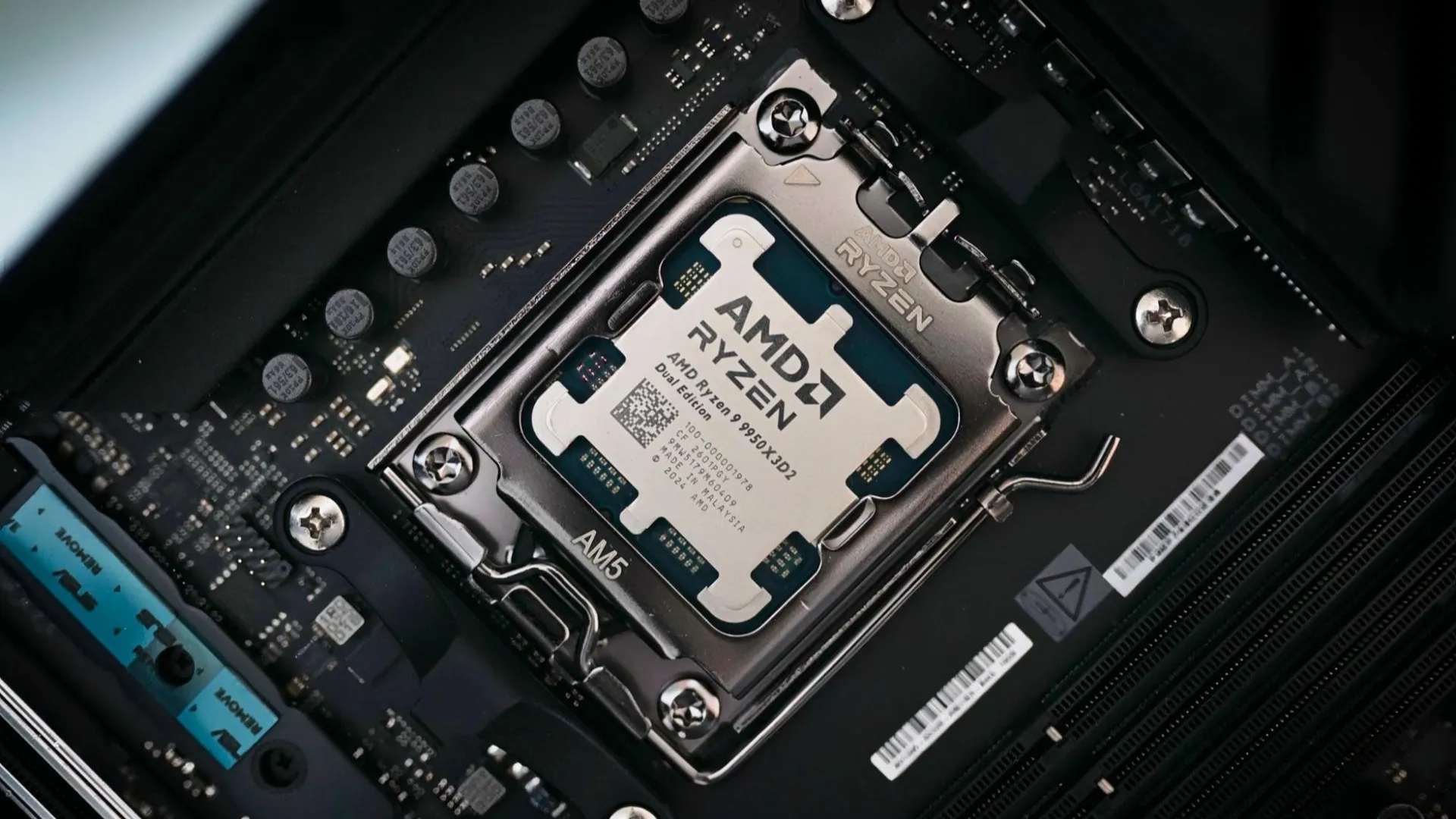
AMD confirms AM5 support through 2029 — Zen 4 and 5 platform will likely see two more generations, at least

AMD
(Image credit: Tom's Hardware)

AMD confirmed that it will support its current AM5 socket through 2029 at Computex 2026. Previously, AMD had only committed to support the socket through 2027. With the extended timeline and AMD’s usual release cadence, support through 2029 should mean we’ll see at least two more generations on the socket as AMD continues to fight for slots among the best CPUs for gaming.

We first saw the AM5 socket with the release of Ryzen 7000 CPUs with the Zen 4 architecture in 2022. At the time, AMD said it would support the socket through “2025+.” With the release of Zen 5 in 2024, AMD extended the window to “2027+.” Now, we’re getting another two-year bump, though without Zen 6 CPUs in hand. We expect to see them soon, however, as AMD continues to double down on Zen 6 arriving in the data center this year.
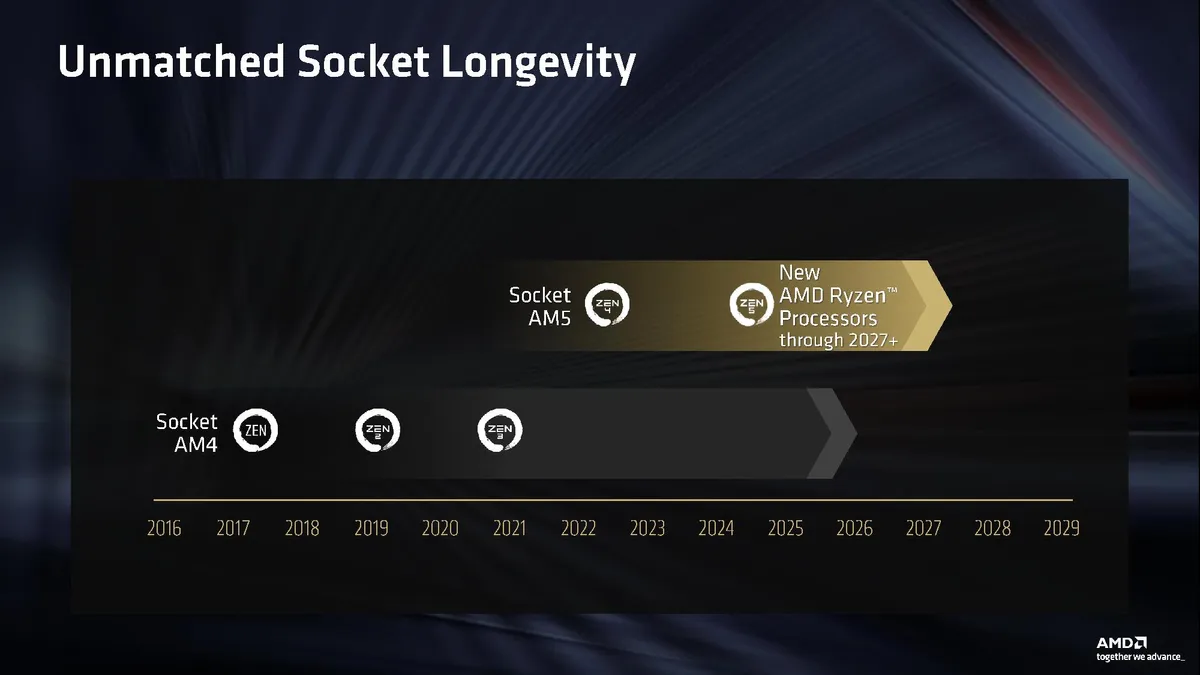
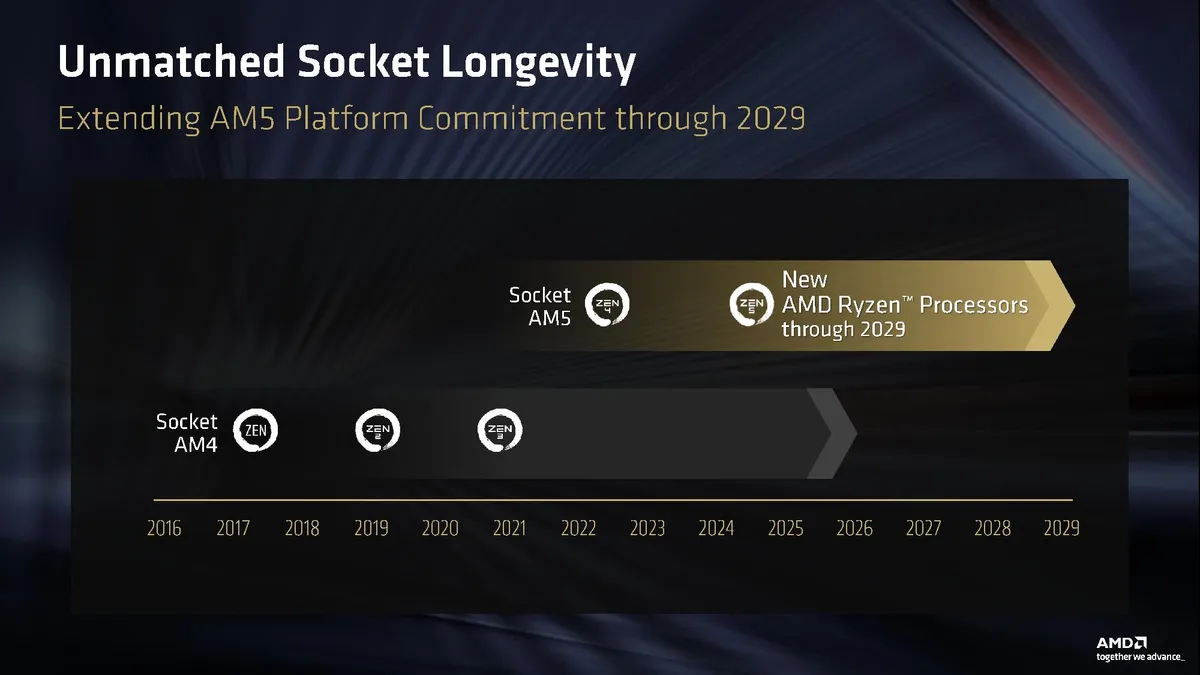
Now, the support window is extended through “2029,” notably without a plus. That may seem like a small difference, but as you can see from AMD’s own slides, it uses “2027+” right next to “2029.” We’ve reached out to AMD to confirm if 2029 is the end of the line for AM5. A company spokesperson responded with the following: "AMD is unable to comment on future products/roadmap."

Latest Videos From

Still, two more generations on AM5, at least, seems likely. With Zen 6 set to arrive later this year in the data center, we should have a new generation on AM5 at some point next year. Assuming another two-year cycle for AMD’s following generation, that means AM5 would go out in 2029 with Zen 7, which we currently expect to see in 2028 (though that timeline could easily change as consumer launches move around in the AI era).

EXPO Ultra Low Latency, with promised 4% uplift coming soon

In addition to extending AM5 support, AMD teased a new version of EXPO automatic memory overclocking feature. EXPO Ultra Low Latency (ULL) is a new version of AMD’s branded memory overclocking that promises an average 4% uplift in performance compared to the first version of EXPO, as well as a 13% jump compared to running DDR5 at JEDEC speeds. AMD hasn’t confirmed when EXPO ULL will launch, outside of the fact that it’s “coming soon” and will be available from several memory partners, including G.Skill, Kingston, V-Color, Teamgroup, Lexar, and XPG.

Google Preferred Source

Follow Tom's Hardware on Google News, or add us as a preferred source, to get our latest news, analysis, & reviews in your feeds.

Jake Roach
Senior Analyst, CPUs

Jake Roach is the Senior CPU Analyst at Tom’s Hardware, writing reviews, news, and features about the latest consumer and workstation processors.

  • Notton
    DDR6 for desktop/consumer isn't coming until 2028 at the earliest, so 2029 for AM5 to AM6 transition seems about right.
    Reply
  • spongiemaster
    The change in dates means nothing and doesn't imply additional generations. AMD still claims to be supporting AM4 because they are releasing bottom of the barrel binned CPU's that no one is interested in and despite the fact the last new Zen generation for it was released way back in 2020.
    Reply
  • thestryker
    If anything is to be assumed based on AMD's listing 2029 without a + it's that Zen 6, and maybe some sort of refresh, is it for AM5. It seems highly unlikely to me that they would launch a new architecture on the platform and have it also be the end.
    Reply
  • Xajel
    So this confirmation almost indirectly semiconfirmed that Zen 7 might be coming to AM5.

    But it also hints that AM6/DDR6 might come later than expected, or at least will be expensive at launch to the point they'll keep AM5/DDR5 a little longer as it becomes a budget options compared to AM6/DDR6, just like how they did with AM4>AM5 transition.
    Reply
  • wakuwaku
    spongiemaster said:
    The change in dates means nothing and doesn't imply additional generations. AMD still claims to be supporting AM4 because they are releasing bottom of the barrel binned CPU's that no one is interested in and despite the fact the last new Zen generation for it was released way back in 2020.
    Yes it does. You need to stop using Tom's as your only source of tech news considering their decline in quality and reckless use of AI to spread misinformation, or lack of information in this case. ALWAYS consume multiple sources of the same news, or better still, drop those that consistently and repeatedly give you wrong or misleading news without any signs of improvements like Toms.

    Here is a HUB video timestamp that shows an AMD slide that Specifically says new architectures:

    eMZwqjvu2Gg:477View: https://youtu.be/eMZwqjvu2Gg?t=477
    Reply
  • bit_user
    spongiemaster said:
    The change in dates means nothing and doesn't imply additional generations. AMD still claims to be supporting AM4 because they are releasing bottom of the barrel binned CPU's that no one is interested in
    Yeah, but wouldn't it be interesting, if they made a new AM4 I/O die that would interface with Zen 4 and Zen 5 CCDs? Wouldn't make a lot of sense to run more than about 8 or 12 cores on DDR4, but it would unlock more performance for folks either still on AM4 boards or sticking with DDR4 for other reasons.

    On the flipside, we've heard most AM4 boards' BIOS is running out of room to include support for new CPU models and a lot of manufactures have dropped support for AM4 boards, by now. So, actually getting new CPU models working on enough of those boards that people can just buy one and expect it to work is probably a big reason why it won't happen.

    spongiemaster said:
    and despite the fact the last new Zen generation for it was released way back in 2020.
    5800X3D launched in April 2022.

    wakuwaku said:
    You need to stop using Tom's as your only source of tech news considering their decline in quality and reckless use of AI to spread misinformation, or lack of information in this case. ALWAYS consume multiple sources of the same news, or better still, drop those that consistently and repeatedly give you wrong or misleading news without any signs of improvements like Toms.
    Eh, I'll believe it when I see it. To release new stuff for AM4 would probably mean going back to the old "+" naming. So, new CPUs might only work on AM4+ boards. Anything else would run into all kinds of BIOS update headaches, like I mentioned above.

    Also, anything that's limited to DDR4 is going to have poor multi-core scaling. So, it really will be something targeted towards the lower end of the market.
    Reply
  • bit_user
    Xajel said:
    it also hints that AM6/DDR6 might come later than expected,
    That's almost certainly due to DDR6 arriving too late to coincide with Zen 7.

    Xajel said:
    or at least will be expensive at launch to the point they'll keep AM5/DDR5 a little longer as it becomes a budget options compared to AM6/DDR6, just like how they did with AM4>AM5 transition.
    I fully expect this, especially if AM6 is a DDR6-only platform.

    I'm beginning to think DDR6 might be the end of the road for regular DDR. After that, even desktop CPUs could switch over to LPDDR.
    Reply
  • thestryker
    bit_user said:
    I'm beginning to think DDR6 might be the end of the road for regular DDR. After that, even desktop CPUs could switch over to LPDDR.
    As much as I hate saying this it's possible DDR6 doesn't even come to desktop (unless the volume is needed for memory manufacturers). Gaming is the predominant client workload that needs low latency and with a large L3 cache DRAM latency is less of a problem. AMD has X3D parts from 6 to 16-cores and all of the leaks for both AMD and Intel indicate the additional cache capacity is increasing for future generations.

    I have a hard time believing that LPCAMM isn't cheaper than DIMMs for everyone involved (not that savings would be passed onto the buyer). I could envision a future where everyone is on LPDDR and if you're a gamer you buy a CPU with extra cache.
    Reply
  • usertests
    thestryker said:
    As much as I hate saying this it's possible DDR6 doesn't even come to desktop (unless the volume is needed for memory manufacturers).
    I don't think that's plausible since it's been on roadmaps, discussed in interviews, and there's been no indication of that.

    What we do know is that there will be no DDR6 SODIMMs. DDR6/LPDDR6/etc. CAMM/LPCAMM will take on the role of mobile/small form factor.

    If we're going to see a major shakeup, I think it would happen with (or in place of) DDR7.
    Reply
  • Gururu
    Now everyone can enjoy ddr5 in 2029. I will be using ddr7 tyvm.
    Reply