









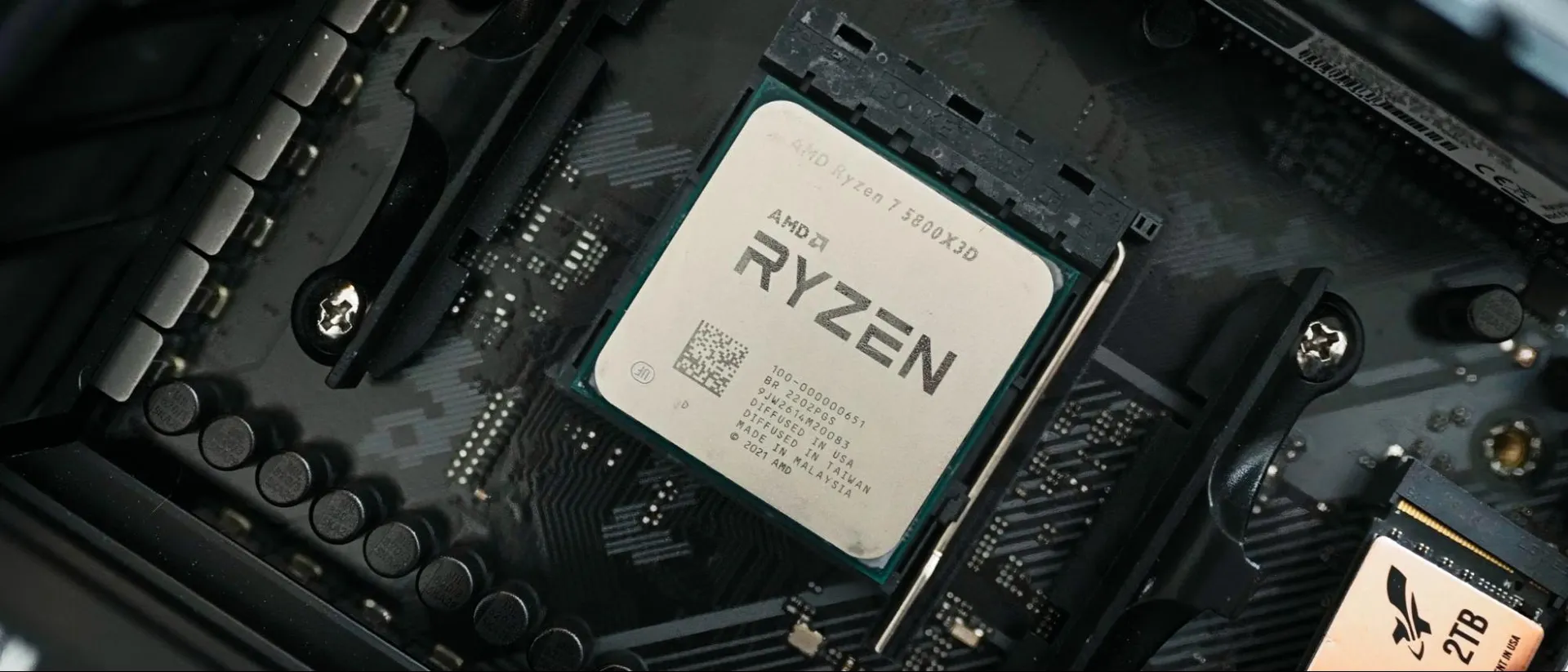
Tom's Hardware Verdict
The Ryzen 7 5800X3D is still a legendary DDR4 processor. The market has moved quickly in the four years since its launch, however, and its re-release price of $350 is tough to justify if you aren’t already invested in the AM4 ecosystem.
Reasons to buy
- +
Top-shelf DDR4 gaming performance
- +
Slots into existing AM4 motherboards with DDR4 support
- +
Highly efficient
- +
Low idle and peak power draw
Reasons to avoid
- -
Limited productivity performance
- -
Relatively expensive at $350
Why you can trust Tom's Hardware Our expert reviewers spend hours testing and comparing products and services so you can choose the best for you. Find out more about how we test.
AMD answered the demands of gamers and re-released the Ryzen 7 5800X3D, though not without compromise. Although the return of Zen 3 X3D has been a good idea for months, given the limited time we saw those chips on the market, this re-release comes with a surprisingly high price, considering the silicon and how it compares to the best CPUs for gaming.
Price is the biggest issue for the Ryzen 7 5800X3D. AMD shaved $100 off the original MSRP for the 10th Anniversary Edition re-release, but that puts it in very competitive waters, even considering current RAM prices. The CPU is flanked on one side by the Core i7-14700K that also supports DDR4 memory, and on the other by the Ryzen 5 7600X3D, which offers superior gaming performance and a lower price to offset the cost of a DDR5 platform.
The chip mainly appeals to those who already have an AM4 motherboard and memory to go with it, and who were unfortunate enough to miss the small window when you could buy the Ryzen 7 5800X3D a few years ago. In that situation, just about any price is a deal compared to the competition.
Otherwise, the Ryzen 7 5800X3D is about $70 to $100 too expensive, and even that lower price would be questionable if DDR5 prices weren’t out of control. Although the chip has earned its legendary status among gamers, revisiting it in 2026 shows clearly that it maxes out what DDR4 platforms are capable of in games, and it falls far too short of the DDR4 competition in applications.
The island of AM4 users stranded without a clear upgrade path will love the 5800X3D re-release. But the chip is not nearly as impressive as it once was if you have to buy a motherboard and/or RAM alongside your CPU, however.
Some notes on this re-review
We don’t normally re-review products here at Tom’s Hardware, much less update existing reviews outside of some extraordinary circumstance. We will follow up reviews with additional coverage as needed, but our reviews are as much buying advice at the time they’re written as they are historical context years down the road. Reviews exist in the context in which they’re written.
That’s important because, especially with PC hardware, some good products can become worse over time and bad products can become good over time. Even in this past generation, AMD had several stumbles with Zen 5, which it addressed post-launch through a combination of firmware updates and exposing additional settings in the BIOS. Intel had some major regressions in performance with Arrow Lake, which it partially addressed after release with Core 200S Boost.
Get Tom's Hardware's best news and in-depth reviews, straight to your inbox.
These products are better now than they were at launch, but it’s still important to know that they had issues at launch. That’s the function of our reviews. They’re a snapshot of how a particular component performs and compares to the rest of the market at a certain point in time. Our list of the best CPUs for gaming and CPU benchmark hierarchy pages are where you’ll find the consistent updates on which chips are best at any given time.
That preamble is to say that this re-review of the Ryzen 7 5800X3D does not replace our original review, which is why this is a separate piece of content and not merely an update. We’re re-reviewing the chip because AMD is re-releasing it, and we need to compare the chip to the current market it exists in.
That market includes high memory prices, which is a driving force behind the re-release of the Ryzen 7 5800X3D in the first place. We’re paying especially close attention to memory in this review, both in terms of price and performance. However, we’ve also brought some price-competitive DDR5 chips into the mix, including some of AMD’s own CPUs.
Finally, we’re reviewing the original Ryzen 7 5800X3D here. AMD says that the new 10th Anniversary Edition should be identical to the original model, but it’s using a slightly different bonding process, which could have a minor impact on power and thermals, in particular. We’ll be getting a 10th Anniversary Edition into the lab in order to find out, but we don’t expect major performance differences between the original and re-release versions.
AMD Ryzen 7 5800X3D specifications and pricing
CPU / (MSRP) |
Street Price |
Architecture |
Cores/Threads (P+E) |
Cache (L2 + L3) |
Base/Boost Clock (GHz) |
TDP / Maximum Power |
Ryzen 7 5800X3D |
Zen 3 X3D |
8 / 16 |
100 MB |
3.4 / 4.5 |
105W / 142W |
|
Core Ultra 7 270K Plus |
Arrow Lake Refresh |
24 / 24 (8+16) |
76 MB |
3.7 / 5.5 |
125W / 250W |
|
Ryzen 5 7600X3D ($300) |
Zen 4 X3D |
6 / 12 |
102 MB |
4.1 / 4.7 |
65W / 88W |
|
Ryzen 7 7800X3D ($450) |
Zen 4 X3D |
8 / 16 |
104 MB |
4.2 / 5 |
120W / 162W |
|
Core i7-14700K ($410) |
Raptor Lake Refresh |
20 / 28 (8+12) |
61 MB |
3.4 / 5.6 |
125W / 253W |
The Ryzen 7 5800X3D is sold out at most retailers, but you can grab it at list price from Amazon right now.
It’s difficult to evaluate the specs of the Ryzen 7 5800X3D given the current market, so this is a refresher of what the processor offers and how it compares to some of the current options featured in our test suite. It’s an eight-core / 16-thread chip sporting AMD’s Zen 3 architecture, and it boosts up to 4.5 GHz, with a base clock of 3.4 GHz.
The chip is fabricated on TSMC’s 7nm FinFET process, with GlobalFoundries stepping in to fab the I/O die on its 12nm process. Of course, the main draw of the CPU is the 64MB chunk of SRAM that’s bonded to the compute die, giving the processor access to a total of 96MB of L3 cache.
In recent years, we’ve seen both AMD and Intel increase cache sizes broadly, not just on X3D CPUs. For instance, the Ryzen 7 9700X has the same 32MB of on-board L3 that we can see all the way back to Zen 3, but it has double the L2 cache. Intel has traditionally split L2 and L3 more evenly, and we’ve seen an increase in both with Arrow Lake and Arrow Lake Refresh.
Still, the huge boost in L3 helps a lot here. It comes with some thermal trade-offs, however. Although the Ryzen 7 5800X3D is a very efficient CPU, it also has careful power management. The SRAM sits on top of the compute die, insulating the cores from the IHS. This thermal design means the Ryzen 7 5800X3D has relatively low peak clock speeds out of the box, and it doesn’t officially support AMD’s Precision Boost Overdrive.
AMD has addressed that issue in newer X3D chips, riding the efficiency of Zen 4 with the Ryzen 7 7800X3D and moving to a new bonding process that situates the SRAM below the compute die with the Ryzen 7 9800X3D.
- MORE: Best CPU for gaming
- MORE: CPU Benchmark Hierarchy
- MORE: Intel vs AMD
- MORE: How to Overclock a CPU
Current page: Revisiting the champ of DDR4 gaming CPUs
Next Page AMD Ryzen 7 5800X3D Gaming Benchmarks
Jake Roach is the Senior CPU Analyst at Tom’s Hardware, writing reviews, news, and features about the latest consumer and workstation processors.
-
Makaveli "and the processor doesn’t officially support AMD’s Precision Boost Overdrive (PBO)"Reply
This is false I owned a 5800X3D and had zero issues running PBO -30 all core on it. -
waltc3 This is AMD's way of acknowledging that due to demand outstripping supply so much presently, that even DDR4 isn't as cheap as it was, so being able to upgrade existing systems is a money-saving event of no small proportion. The whole point of the 10th Anniversary sale is strictly for people with an AM4 motherboard who are still using it (likely several million, I'd think, including a working AM4 at my home) who want to buy the fastest gaming CPU on the market for AM4, and that would be this CPU, the re-designed and re-engineered 5800x3d...;) (It's a brand-new CPU from the ground up as the original could no longer be manufactured.) Comparing it to Intel parts is really silly, I think, since none of them can drop in on an AM4 motherboard, and so if you are going to compare Intel CPUs then figure in the costs of everything else needed for the Intel CPU to run--like the mobo and the ram, for instance, etc. This release was not meant to do anything but allow existing AM4 owners to get a lot of extra mileage out of their existing AM4 parts still in service, when nothing else will do. AMD delights in treating its customers well, I think, and often goes beyond what might be expected normally for customers of previous products...;) Interesting times.Reply -
JakeRoach Reply
It depends on your motherboard. But yes, some boards support it, so I've removed the mention from the article.Makaveli said:"and the processor doesn’t officially support AMD’s Precision Boost Overdrive (PBO)"
This is false I owned a 5800X3D and has zero issues running PBO -30 all core on it. -
phxrider It's overpriced, but it's perfectly priced to sell to people who already have am4 systems and can't afford a full platform upgrade and ddr5 RAM.Reply -
ohio_buckeye Replywaltc3 said:This is AMD's way of acknowledging that due to demand outstripping supply so much presently, that even DDR4 isn't as cheap as it was, so being able to upgrade existing systems is a money-saving event of no small proportion. The whole point of the 10th Anniversary sale is strictly for people with an AM4 motherboard who are still using it (likely several million, I'd think, including a working AM4 at my home) who want to buy the fastest gaming CPU on the market for AM4, and that would be this CPU, the re-designed and re-engineered 5800x3d...;) (It's a brand-new CPU from the ground up as the original could no longer be manufactured.) Comparing it to Intel parts is really silly, I think, since none of them can drop in on an AM4 motherboard, and so if you are going to compare Intel CPUs then figure in the costs of everything else needed for the Intel CPU to run--like the mobo and the ram, for instance, etc. This release was not meant to do anything but allow existing AM4 owners to get a lot of extra mileage out of their existing AM4 parts still in service, when nothing else will do. AMD delights in treating its customers well, I think, and often goes beyond what might be expected normally for customers of previous products...;) Interesting times.
Don’t be mistaken here. I run AMD at home myself and have built a lot of AMD systems. But they are a company that needs money just like Intel and nvidia. If they see am5 sales taking hits due to ram pricing, this was a logical move. -
Droz23 I really love the analysis. On the face of the charts for the 5800x3D from the forums is can be seen how it lags after all these years but is still competitive. The really equalizer is the resolution and the bolt on Tech for GPU's. Once the test are done above 1080P, say 1440p. The Delta's shrink massively do to binding. This lets the 5800x3D stay relevant for quite awhile. the GPU manufactures serve the AI God but still have a reason to keep face in the PC market. So the tech is getting passed down for free for the most part. As drivers get upgraded, performance increases. There is still a few years left on this CPU.Reply -
Toylander Reply
I've been ummming and amming for a while now on which way to upgrade my system, it's been a shaky path since covid, I had my 3070 RTX OC sat on the shelf for a while when gpu prices went silly, and eventually moved it from my hp twin xeon workstation to an am4 platform system. I started looking at upgrading the 8gb of ram but even ddr4 is now ridiculous and used prices higher than new… is this a worthy upgrade at the cost even if I manage to sell on my used ryzen 5 5600xt or would I be better off with the am5 platform and a better cpu for less or the same with a budget board, and then spend on the minimum of ddr5 ram. With rumours or ddr4 going back into production I question if it's worth trying to skip a generation it doesn't look like ddr5 is for the consumer market at present are AMD on to something here isAdmin said:AMD has re-released the Ryzen 7 5800X3D to provide some relief from high DDR5 prices, so we’re re-reviewing the CPU to see how it stacks up to current options around the same price.
AMD Ryzen 7 5800X3D re-review: Maxing out DDR4’s gaming potential : Read more
the am4 platform is in line for a series of other upgrades? -
Dntknwitall They released the chip for people looking to upgrade that are on lower DDR4 chips so obviously they will be invested in DDR4. Whoever wrote this needs to be demoted to janitorial duties. $350 for the highest DDR4 chip for gaming is not a bad deal try buying it in Canada where it is going for $600+. I just paid 300 CAD for a 10700k to replace a 10100 chip so things are very expensive in the north and not getting better. Prices do not reflect value anymore so writting articles like they do is just dumb in my opinion.Reply -
cp0x This CPU will be back down to $250 in a few months. The retailers are being forced by AMD to set the price temporarily up to $349.99 just because that's a condition of getting any initial allocation. Stupid game by AMD that they also played with the 9950x3d2.Reply -
salgado18 So the winner is... the Ryzen 5 7600X3D? Seriously, that's the value king right now, right?Reply
Oh, and if you play at 60 fps, a 5700X is enough (for now)