









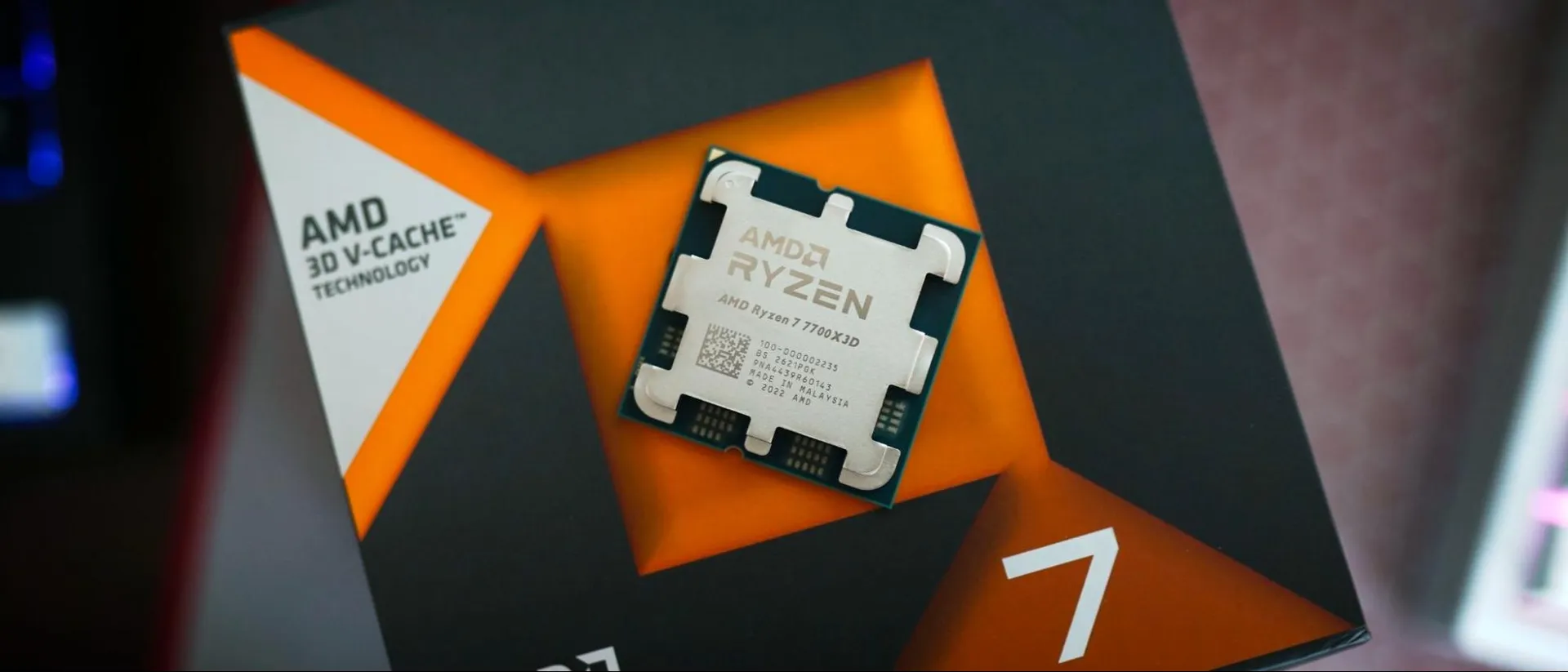
Tom's Hardware Verdict
The Ryzen 7 7700X3D offers 7600X3D-like gaming performance, just at a higher price. A price cut to between $250 and $280 would make it far more competitive with Intel’s offerings, as well as AMD’s other Zen 4 X3D chips.
Reasons to buy
- +
Slots into existing AM5 boards, no BIOS update required
- +
Remarkable efficiency in games, often better than 7800X3D
- +
Within 5% of the gaming performance of the 7800X3D
Reasons to avoid
- -
Only 2% faster than 7600X3D, despite $90 price increase
- -
Weak single- and multithreaded application performance
- -
Expensive at $330
Why you can trust Tom's Hardware Our expert reviewers spend hours testing and comparing products and services so you can choose the best for you. Find out more about how we test.
The 7700X3D always made sense. Ever since the 5800X3D released and showed itself as the best CPU for gaming (at the time), AMD has continued to double down on 3D V-Cache, dominating the competition from Intel in games by double-digit margins. Because of the immense success of X3D CPUs, we’ve seen several variations with lower bins. Originally we had the 7800X3D, and now we have the 7700X3D. It’s cheaper and has lower boost clocks, but it gives you the same eight Zen 4 cores and 104 MB of combined L2 and L3 cache. It’s a 7800X3D for less money.
That, at least, is the assumption. Reality is a bit different.
A little less than two years after the 5800X3D released, AMD introduced the 5700X3D. Like the 7700X3D, it came with a cut to maximum boost clocks (400 MHz with the 5700X3D instead of 500 MHz here, but we’re splitting hairs), but still largely offered the gaming performance of the 5800X3D for less money. The problem here is that, although the 7700X3D could be a worthy successor to the 5700X3D, it’s too expensive.
The 5800X3D released in April 2022 for a suggested price of $450. Flash forward to January 2024, and the 5700X3D rolls out at $250. The 7800X3D launched in April 2023 for $450. The 7700X3D is arriving more than three years later in July 2026 for a suggested retail price of $330. It’s safe to call the 7700X3D a day late and a buck short, even ignoring the external pricing circumstances of the DIY market now.
That’s just a high-level analysis of launch pricing, too. Looking at prices now, the comparison is even more rough. Intel’s Core Ultra 7 270K Plus is the same price, within 5% of average gaming performance, 2X multi-threaded performance, and around 40% faster in single-core performance. AMD’s own Ryzen 7 7800X3D is, at the time of writing, available for $349, just $20 more than the 7700X3D (though I suspect that price will change). Buy a secondhand 7800X3D from Amazon, and it’s cheaper than the 7700X3D.
And, if you’re just focused on gaming performance and getting the best bang for your buck, the Ryzen 5 7600X3D is around $100 cheaper than the 7700X3D and within 2% of the average gaming performance.
The 7700X3D performs exactly how I expected it to. It’s not as fast as the 7800X3D, but if you squint hard enough, it’s close enough. It’s just too expensive. At $330, you’re almost forced to step up or down to AMD’s other Zen 4 X3D chips to get into a value sweet spot, and if you’re not solely focused on gaming, Intel offers much more powerful CPUs around the same price.
Get Tom's Hardware's best news and in-depth reviews, straight to your inbox.
If the 7700X3D followed in the 5700X3D’s footsteps and released at $250 (even after three years of the 7800X3D on the market), it’d be a slam dunk. That’s not where we are for release, so let’s hope a price cut is waiting in the wings.
AMD Ryzen 7 7700X3D specifications and pricing
CPU / (MSRP) |
Street Price |
Architecture |
Cores/Threads (P+E) |
Base/Boost Clock (GHz) |
Cache (L2 + L3) |
TDP / Maximum Power |
Ryzen 9 7950X3D ($700) |
Zen 4 X3D |
16 / 32 |
4.2 / 5.7 |
144 MB |
120W / 162W |
|
Ryzen 9 7950X ($700) |
Zen 4 |
16 / 32 |
4.5 / 5.7 |
80 MB |
170W / 230W |
|
Ryzen 7 7900X3D ($600) |
Out of Stock |
Zen 4 X3D |
12 / 24 |
4.4 / 5.6 |
140 MB |
120W / 162W |
Ryzen 9 7900X ($550) |
Zen 4 |
12 / 24 |
4.7 / 5.6 |
76 MB |
170W / 230W |
|
Ryzen 7 7800X3D ($450) |
Zen 4 X3D |
8 / 16 |
4.2 / 5 |
104 MB |
120W / 162W |
|
Ryzen 7 7700X3D ($330) |
$330 |
Zen 4 X3D |
8 / 16 |
4 / 4.5 |
104 MB |
120W / 162W |
Ryzen 7 7700X ($400) |
Zen 4 |
8 / 16 |
4.5 / 5.4 |
40 MB |
105W / 142W |
|
Ryzen 5 7600X3D ($300) |
Zen 4 X3D |
6 / 12 |
4.1 / 4.7 |
102 MB |
65W / 88W |
|
Ryzen 5 7600X ($300) |
Zen 4 |
6 / 12 |
4.7 / 5.3 |
38 MB |
105W / 142W |
There’s a good chance the Ryzen 7 7700X3D is the last X3D processor we’ll see sporting AMD’s Zen 4 architecture, short of a potential Ryzen 5 7500X3D in the future. It further segments AMD’s last-gen lineup, and although there’s good pricing separation between each of the Zen 4 options, the spec differences are small.
For the Ryzen 7 7700X3D, the only spec difference it carries is a cut to clock speed compared to the Ryzen 7 7800X3D. You lose 200 MHz on the base clock and 500 MHz on the maximum boost clock. It’s a similar setup to what we saw with the Ryzen 7 5800X3D and 5700X3D, just a bit more aggressive. The 5700X3D shaved 400 MHz off the base and boost clock of the 5800X3D.
Otherwise, you’re getting the same eight Zen 4 cores available in the 7800X3D, along with 104 MB of combined L2 and L3 cache (64 MB of that L3 is stacked on the CCD). It also comes with the same rated TDP of 120W, though as we’ll see throughout our benchmark results, the 7700X3D never crossed into triple-digit wattages during our testing.
The 7700X3D slots into existing 600- and 800-series motherboards, and AMD says that it will boot on existing AM5 BIOS images (though the company recommends flashing the latest firmware). We didn’t need to install a specific BIOS image or chipset drivers to boot with the 7700X3D, so if you already have an AM5 motherboard, you should be set. In addition, the 7700X3D does not come with a stock cooler, despite arriving in AMD’s larger box design that we saw in the previous generation.
Outside of the step up to the 7800X3D, there’s a step down to the 7600X3D, which trades two cores (and consequently 2 MB of L2 cache) for a bump to a 4.7 GHz boost clock. As we’ll get to in our gaming benchmarks, there’s something about the range of 4.5 to 4.8 GHz where these Zen 4 X3D chips hit their stride, and the 7700X3D just barely hits that range without PBO assistance.
The 7700X3D arrives at a recommended retail price of $330, putting it in hotly contested waters. Intel has its newer 270K Plus around that same price, while the last-gen Core i7-14700K lands closer to the $380 mark. Down a step, the 250K Plus is more than $100 cheaper at $220, while the Core i5-14600K is available for around $250.
For AMD, you can step up to the 7800X3D for a $50 premium (at current prices) or down $90-$100 and get the 7600X3D. Of this tight grouping of Zen 4 X3D chips, none of them are bad options purely for gaming. Deciding between them is tricky. We’ve seen the 7800X3D on sale for as low as $348, which is a negligible price difference compared to the 7700X3D. And even at list price, the Ryzen 5 7600X3D is significantly cheaper, yet comes within just two points of the average gaming performance of the 7700X3D.
It’s impossible to give a concrete conclusion about which is the best because even a minor sale of $20 or $30 off tips the scales. The 7700X3D isn’t a bad processor, but there are a lot of situations where it’s not the optimal choice, mainly due to its proximity in price to the 7800X3D. Given the 7700X3D’s performance, it would ideally be priced around $260 to $280.
You’ll spend much more if you want to get one of AMD’s latest X3D chips with the Zen 5 architecture, which represent somewhere around a 15% to 20% improvement in average gaming performance. The 9800X3D is the cheapest Zen 5 X3D processor right now, and you can expect to spend about $450 to $480 on one. AMD suggested to Tom’s Hardware that it’s looking into a cheaper Ryzen 5 9600X3D for a future release, but that’s not available at the moment.
- MORE: Best CPU for gaming
- MORE: CPU Benchmark Hierarchy
- MORE: Intel vs AMD
- MORE: How to Overclock a CPU

Jake Roach is the Senior CPU Analyst at Tom’s Hardware, writing reviews, news, and features about the latest consumer and workstation processors.
-
usertests The market will correct the price... possibly by raising the 7800X3D price.Reply
It's good and efficient out of the box. -
-Fran- Another swing and miss from AMD!Reply
Like... Why even release this CPU in this market AMD? Why not just stock pile it and sell it later when it makes more sense?
You're barely moving the 7800X3D at really good prices, how do you expect to move this thing at a worse P/P ratio? HOW?
Regards. -
vinay2070 Reply
Maybe they were not clocking as good as a 7800X3D and AMD still wanted to sell them? So they waited till they had enough of them and then started selling?-Fran- said:Another swing and miss from AMD!
Like... Why even release this CPU in this market AMD? Why not just stock pile it and sell it later when it makes more sense?
Why sell later though, there would be 9700X3D piling up which AMD may want to sell later. -
Why_Me PCPartPicker Part ListReply
CPU: *AMD Ryzen 7 7700X3D 4 GHz 8-Core Processor ($279.99 @ Newegg)
Total: $279.99
Prices include shipping, taxes, and discounts when available
*Lowest price parts chosen from parametric criteria
Generated by PCPartPicker 2026-07-17 01:14 EDT-0400
PCPartPicker Part List
CPU: *AMD Ryzen 7 7800X3D 4.2 GHz 8-Core Processor ($348.99 @ Amazon)
Total: $348.99
Prices include shipping, taxes, and discounts when available
*Lowest price parts chosen from parametric criteria
Generated by PCPartPicker 2026-07-17 01:15 EDT-0400 -
ohio_buckeye What’s funny is they reference a potential future Ryzen 5 7500x3d in the future. However that cpu already exists and has for a while as that’s the cpu currently in my pc.Reply
Anyway what stands out to me at least is I was watching a video review on the 7700x3d and of course they were using a 5090 and had various x3d CPUs shown including the 7800x3d and 9800x3d etc.
As someone who already owns a 7500x3d I personally don’t see a need to even upgrade to a 9800x3d for example. I mean yeah I’d get a little better fps but when they’re showing these paired up to a 5090 and running at 1080p, who’s doing that unless you are benchmarking or you are a professional gamer with money to burn and that’s all you’re doing all day every day? If you are an average person with say a 9070xt and you’ve got say a 7500x3d, I don’t see that when a 9800x3d is a meaningful upgrade. Really in those conditions even a normal 7700x is likely plenty.
In my case a 7500x3d is pretty close to a 7600x3d which I think is nipping at the heels of this 7700x3d. With the current prices on ram and ssds and given the price of what you can get a 7800x3d for, and rumors of zen 6 right around the corner with zen 7 in a year or so possibly being on am5, I think personally I’m going to just hold where I’m at. I personally have the 7500x3d with 32gb ddr5 and an rx 6950xt at 3440x1440. So in my case I think I’m waiting for next gen gpus and see if there are any that are interesting enough to jump to. After that I think I may hold to see if zen 7 will be am5 compatible and if so then at sooner point grab one of the better x3d cpus from zen 7 and I’ll be set for another 2-3 years or more.
Seems like with the 7800x3d at the price it is they need to lower prices on the 7700x3d. If they were selling for $259 or $275 then yeah they’d have a winner. But the 7700x3d feels proved too closely to the faster cpu. Honestly, I think the 5800x3d is in the neighborhood of the 7500/7600x3d. If you’re someone on am4 still with 32gb or 64gb of ram or higher and gaming is your thing, you might be better off to bite the bullet and pick up the 5800x3d and call it a day as opposed to going for a 7700x3d at least at this price when you factor in memory etc. -
-Fran- Reply
Why ignore the paragraph where I explain the reasoning? It's ok to disagree with it, but don't omit it?vinay2070 said:Maybe they were not clocking as good as a 7800X3D and AMD still wanted to sell them? So they waited till they had enough of them and then started selling?
Why sell later though, there would be 9700X3D piling up which AMD may want to sell later.
Weird habit for some...
Regards. -
Neilbob Reply
Well put. When looking at these reviews, it's very important for people to remember that, in the vast majority of cases, these margins will not be applicable for the sorts of GPUs they are very likely to possess. I understand perfectly why the reviews are conducted this way, but they don't help at all to reflect a realistic setup or use case except for a token few.ohio_buckeye said:Good summary
Also applies to the 5800X3D, which I hope to one day acquire at a hopefully slightly lower price, then a new GPU would follow after, but one most likely in the 9060/5060 tier on the (seemingly remote) chance that those prices become a bit less insane too (no splurging right now). That combination would tide me over for a very long time, and might even be the last system I own before I check out. -
vinay2070 Reply
I didnt have to, the dude above your original post already gave the reason - the market will correct it. My main point was 9700X3D has to be released at some point in time. There is no point in releasing both the 7700X3D and 9700X3D at the same time as they are both on AM5.-Fran- said:Why ignore the paragraph where I explain the reasoning? It's ok to disagree with it, but don't omit it?
Weird habit for some...
Regards. -
helper800 My problem with the 7700X3D is that its barely a stones throw away from the 270k plus in gaming performance, and anything not gaming the 270K plus meets and likely beats it into the ground. At least with the 7800X3D there is a much higher performance uplift from the 270k plus, so its more understanding in the same price range. Add into that the much better for cost z890 motherboards, and I do not see this competing well until about 260 dollars.Reply -
usertests Phoronix got my attention:Reply
AMD Ryzen 7 7700X3D Linux PerformanceOn a geo mean basis, the AMD Ryzen 7 7700X3D was running at 97.8% the performance of the Ryzen 7 7800X3D. But its CPU power on average was at 89% that of the 7800X3D. Or on a cost basis, the Ryzen 7 7700X3D at $329 is about 78% the cost of the Ryzen 7 7800X3D cost today at around $419.
You can often get the 7800X3D much cheaper than that, but in general, you are getting much of the performance with a decent reduction in power.
If the 7700X3D needs to become cheaper to diverge from the 7800X3D, it actually can and will. Since it's not a GPU with expensive memory inside.