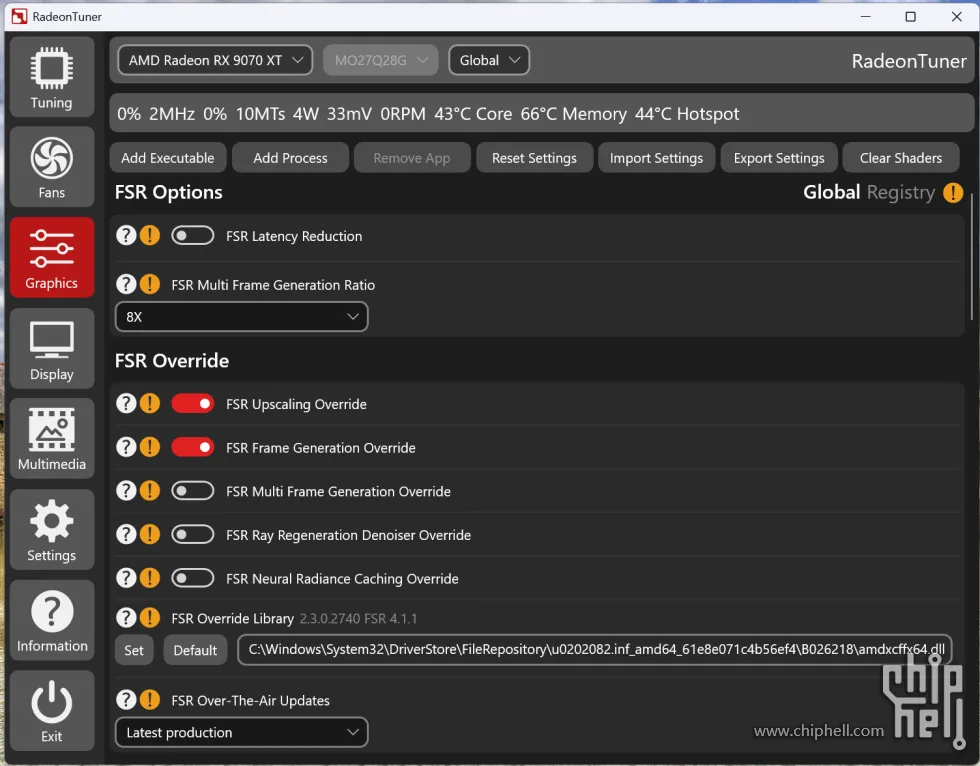
AMD is reportedly testing FSR Multi Frame Generation for existing Radeon GPUs, with ratios of up to 8x. According to a screenshot shared on the Chiphell forums, AMD's latest Adrenalin Edition 26.6.2 driver includes support for Multi Frame Generation, as hidden experimental settings were discovered in RadeonTuner, a third-party open-source alternative to AMD Adrenalin Software. In addition to a new Multi Frame Generation Ratio setting, RadeonTuner also includes override options for FSR Ray Regeneration Denoiser and FSR Neural Radiance Caching.
This suggests that AMD is potentially testing FSR Multi Frame Generation, with options ranging from 1x to 8x. In theory, that could boost a base frame rate of 60 FPS to as high as 480 FPS, which is around 2x higher than what Nvidia currently offers on its RTX 50 series GPUs. That said, these settings are non-functional, and there is no confirmation whether AMD has plans to roll out an 8x Multi Frame Generation mode.
(Image credit: Chiphell Forums)
The discovery has also prompted a response from the developer of RadeonTuner on GitHub, where they explained that AMD occasionally adds the names of upcoming settings to its drivers months before the actual functionality is implemented. The developer also clarified that the newly listed Multi Frame Generation ratios of up to 8x are placeholders that have been added for testing purposes, meaning that it may or may not align with the final implementation that AMD ends up supporting eventually.
Interestingly, during Microsoft's recent unveiling of its upcoming Xbox platform codenamed Project Helix, the company confirmed that the console will feature FSR Diamond (previously called FSR Next). This was touted as an AI-powered rendering suite that would include machine learning-based upscaling, ray regeneration, and Multi Frame Generation. AMD's graphics chief, Jack Huynh, later described FSR Diamond as the result of a multi-year engineering collaboration with Microsoft.
While there is no indication that the hidden driver settings are directly tied to FSR Diamond, the presence of experimental options for Multi Frame Generation, Ray Regeneration, and Neural Radiance Caching suggests AMD is laying the groundwork for its next-generation FSR technologies across the Radeon ecosystem.
Kunal Khullar is a contributing writer at Tom’s Hardware. He is a long time technology journalist and reviewer specializing in PC components and peripherals, and welcomes any and every question around building a PC.
Reception for this over on VideoCardz was pretty poor. But it's probably what you need to fill in the new 1000 Hz displays. Whether or not it's worthwhile is up to you.
Not totally surprising. Not as though you have to enable it. If you think about it though people at first may not have liked dlss or fsr, but now those are pretty well accepted. Give it time these technologies may turn out good later.
Reception for this over on VideoCardz was pretty poor. But it's probably what you need to fill in the new 1000 Hz displays. Whether or not it's worthwhile is up to you.
I don't really see any problem with the feature and assume the "8x" more of checking a box than anything else. The big issue is that AMD's current frame generation is basically junk and only sometimes works acceptably on a game by game basis. Assuming the goal of their new FG/MFG is primarily to resolve that then everyone should be pretty happy with it. I know I tend to target 120 fps and would happily turn on 2x FG in some games to match the refresh rate on my monitor if it wasn't junk.