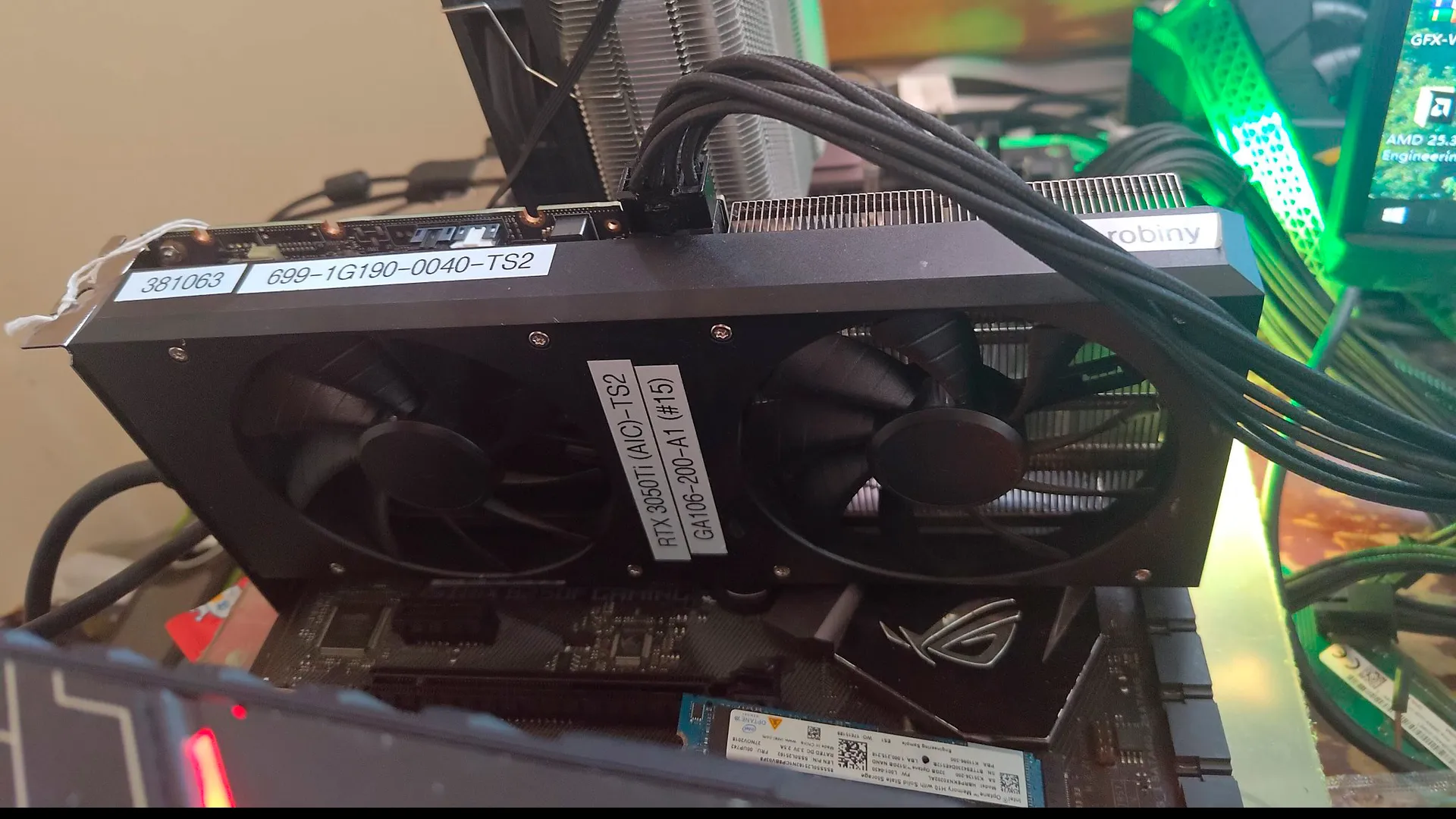
Nvidia’s GeForce RTX 30 series (codenamed Ampere) firmly established itself among the best graphics cards of its time. Interestingly, it seems that Nvidia may have left some money on the table with Ampere. The latest photographs and benchmark results shared by hardware leaker Gok clearly show that the GeForce RTX 3050 Ti is real and has at least reached the prototype stage.
Nvidia did bring a GeForce RTX 3050 Ti to the market, but only for laptops, catering primarily to mobile gamers. What we're seeing today is the desktop version, which should not be confused with the GeForce RTX 3050 Ti Mobile or the GeForce RTX 3050 Ti Max-Q for laptops. Ampere was a popular and successful architecture for Nvidia. However, the downsides of Ampere's launch during the great graphics card shortage, first caused by the cryptocurrency mining boom and second by the COVID-19 pandemic, probably deterred Nvidia from releasing the GeForce RTX 3050 Ti.
The GeForce RTX 3050 Ti engineering sample, reportedly from a company named Robiny, leverages the PG190 SKU 40 design board. It employs the GA106 silicon, the same die utilized in other popular Ampere products, including the GeForce RTX 3050 and the GeForce RTX 3060. As you can tell from the model name, the GeForce RTX 3050 Ti slots in between the two aforementioned models. Once again, it's just an example of Nvidia's strategy to recycle high-end silicon to serve different market segments.

Nvidia GeForce RTX 3050 Ti Specifications
Graphics Card | GeForce RTX 3060 | GeForce RTX 3050 Ti* | GeForce RTX 3050 |
|---|---|---|---|
Architecture | GA106 | GA106 | GA106 |
Process Technology | Samsung 8N | Samsung 8N | Samsung 8N |
Transistors (Billion) | 12 | 12 | 12 |
Die size (mm²) | 276 | 276 | 276 |
SMs | 28 | 26 | 20 |
GPU Cores | 3,584 | 3,328 | 2,560 |
Tensor Cores | 112 | 104 | 80 |
RT Cores | 28 | 26 | 20 |
Base Clock (MHz) | 1,320 | 1,410 | 1,552 |
Boost Clock (MHz) | 1,777 | 1,665 | 1,777 |
VRAM Speed (Gb/s) | 15 | 14 | 14 |
VRAM (GB) | 12 | 6 | 8 |
VRAM Bus Width | 192 | 192 | 128 |
ROPs | 48 | 48 | 48 |
TMUs | 112 | 104 | 80 |
Bandwidth (GB/S) | 360 | 336 | 224 |
TGP (watts) | 170 | ? | 130 |
Launch Date | February 2021 | N/A | January 2022 |
Launch Price | $329 | N/A | $249 |
*Specifications are unconfirmed by Nvidia.
A perfect GA106 silicon has 30 Streaming Multiprocessors (SMs), but the GeForce RTX 3050 Ti has only 26 enabled, resulting in approximately 87% die utilization. With 26 SMs active, the Ampere-based graphics card features 3,328 CUDA cores, which is about 7% fewer than the GeForce RTX 3060, yet 30% more than the GeForce RTX 3050. The configuration puts the GeForce RTX 3050 Ti in a sweet spot, balancing performance and power efficiency.
The clock speeds for the GeForce RTX 3050 Ti fall well within expectations. The base and boost clocks are higher than those of the GeForce RTX 3060 because the GeForce RTX 3050 Ti has fewer CUDA cores. Conversely, the clock speeds are somewhat lower than those of the standard GeForce RTX 3050, which features even fewer CUDA cores.
On the contrary, the memory subsystem of the GeForce RTX 3050 Ti is a cross between those of the GeForce RTX 3050 and the GeForce RTX 3060. While it retains the 14 Gb/s GDDR6 memory modules found in the former, the memory operates over a wider 192-bit interface, similar to the latter's. As a result, the GeForce RTX 3050 Ti offers 50% higher memory bandwidth than the GeForce RTX 3050 but trails behind the GeForce RTX 3060 by 7%.
Unreleased RTX3050Ti DesktopPG190 SKU40GA106-200-A1 pic.twitter.com/BIiXHAm2CkJune 5, 2026
The GeForce RTX 3050 Ti's memory capacity raises some eyebrows. The graphics card appears to carry 6GB of GDDR6 memory, half of what's available on the GeForce RTX 3060 and 2GB less than a GeForce RTX 3050. For reference, we’re comparing the original models of the GeForce RTX 3060 and GeForce RTX 3050, which shipped with 12GB and 8GB of memory, respectively. Nvidia has introduced different memory configurations over time, including the GeForce RTX 3060 8GB, GeForce RTX 3050 6GB, and GeForce RTX 3050 4GB, as well as a couple of variations with different silicon revisions.
Gok shared a screenshot of the GeForce RTX 3050 Ti achieving a graphics score of 7,787 points in 3DMark's Time Spy benchmark. A quick search shows the GeForce RTX 3060 scoring between 8,200 and 9,000 points on the same benchmark. Meanwhile, the GeForce RTX 3050 scores range from 5,300 to 6,400. If we use the maximums for comparison, the GeForce RTX 3050 Ti could be up to 22% faster than the GeForce RTX 3050 or up to 13% slower than a GeForce RTX 3060.
The GeForce RTX 3050 and GeForce RTX 3060 launched at $249 and $329, respectively. The GeForce RTX 3050 Ti could easily have filled the gap at $289. Then again, Ampere was around during difficult times where MSRPs didn't mean anything. The GeForce RTX 3060 still reigns as the most popular graphics card on Steam even to this day. Sadly, we can't rewind time to see what would have happened if the GeForce RTX 3050 Ti had come out. In any event, the graphics card would have further strengthened Nvidia's hold in the mid-range segment. With custom GeForce RTX 3060 starting at $479 nowadays, budget gamers could use another alternative, and something like the GeForce RTX 3050 Ti could certainly fill that spot.

Follow Tom's Hardware on Google News, or add us as a preferred source, to get our latest news, analysis, & reviews in your feeds.