Enthusiast creates Peltier thermoelectric cooler from scratch — impressive rig uses two 360mm AIOs, homemade DC controllers, and a custom loop
It works, but the performance results are underwhelming
Peltier liquid cooling has always been exotic and niche, but only CPU coolers have adopted the technology, leading to the question of whether or not GPUs can benefit from this cooling solution as well. TrashBench on YouTube answered that question in a recent video, putting an RTX 4060 and RTX 3070 to the test using a homemade Peltier liquid cooling system using AIOs, a custom loop, and homemade DC controllers. Sadly, testing revealed that despite having thermoelectric properties, the results were underwhelming.
For the uninitiated, Peltier liquid cooling takes advantage of the thermoelectric effect to achieve sub-ambient temperatures. A semiconducting material is attached to a liquid cooling system and an electric power source. Electricity cools one side of the semiconducting material but generates heat on the other side. In practice, liquid coolers with this tech rely on the semiconducting material to cool the chip, while the liquid cooling portion is largely focused on removing heat from the semiconducting material itself.
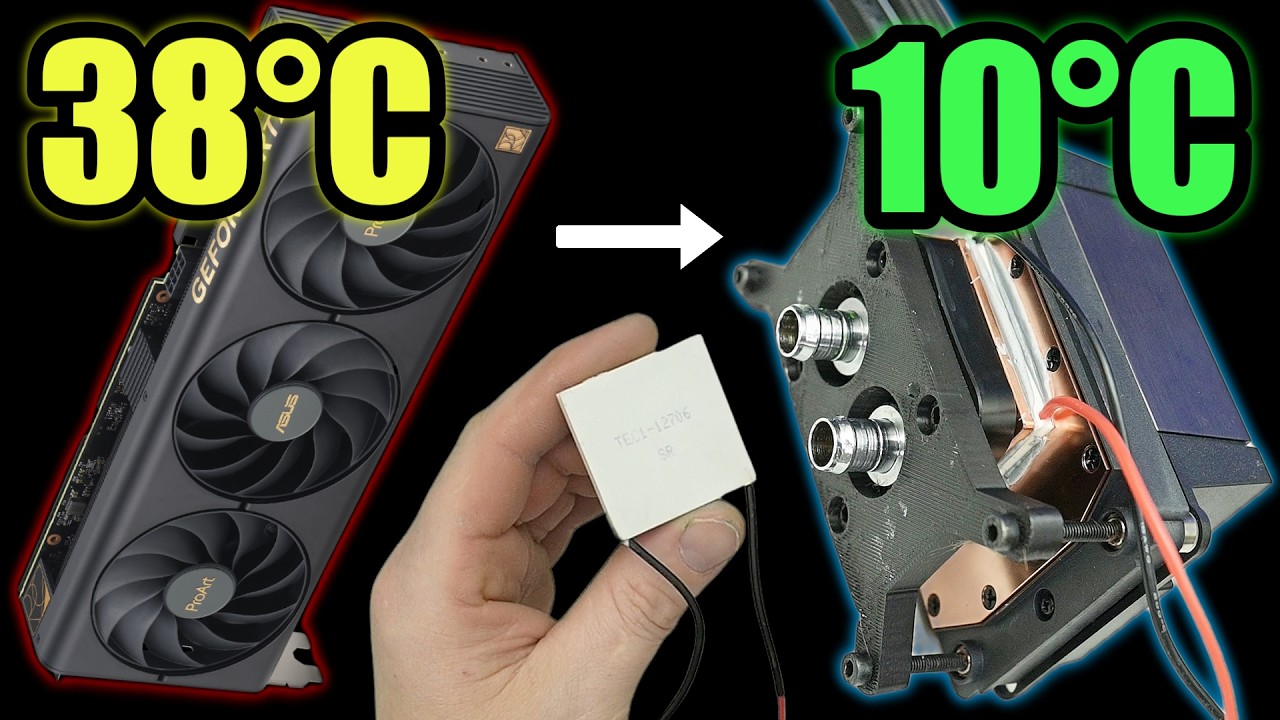
TrashBench's homemade Peltier cooling solution was comprised of a complex arrangement of controllers, radiators, tubing, and even AIO liquid coolers. Two Arctic 360mm AIOs were used to cool the Peltier units alone, and two homemade DC controllers were attached to the Peltier units to regulate power. Waterblocks were attached to the other side of the Peltier units to cool the liquid coming from the GPU waterblock. Both Peltier coolers together consumed 360 watts of power.
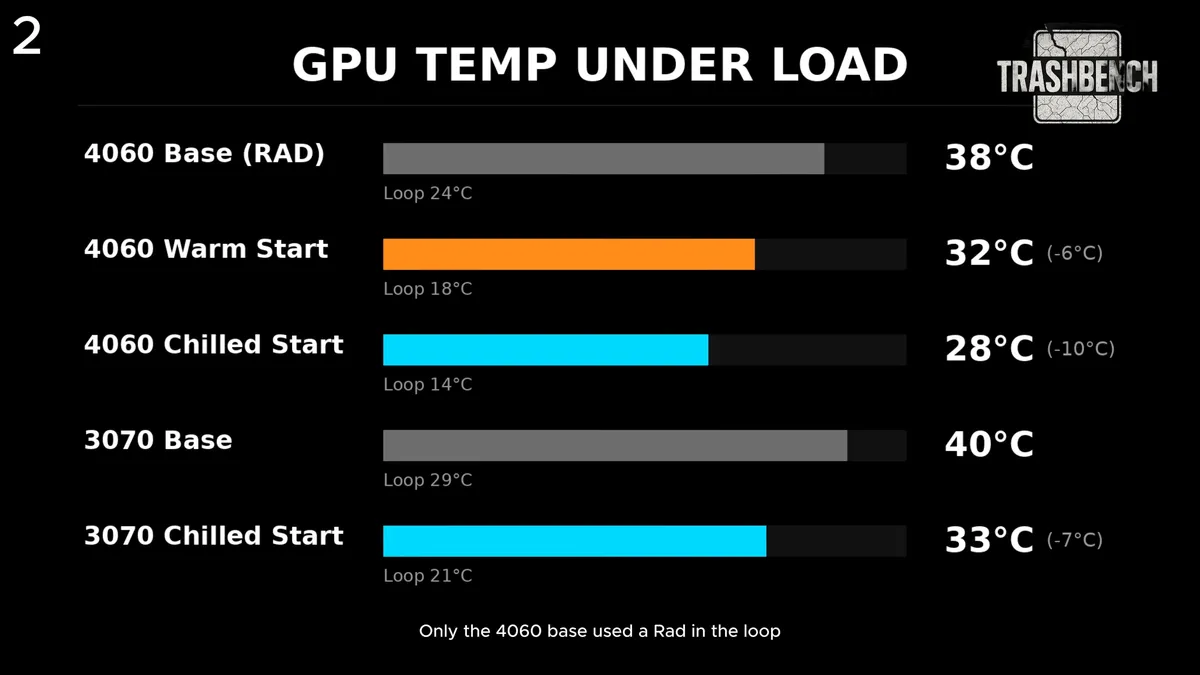
To start, TrashBench benchmarked an RTX 4060 with the Peltier coolers active to get a baseline, achieving 38 °C on the GPU core, and 24 °C liquid temperature with 23 °C ambient air. With the twin Peltier coolers active, the RTX 4060's GPU temperature dropped by 10 °C to 28 °C, and liquid temperatures dropped by 10 °C as well, down to 14 °C after 20 minutes of load in 3DMark Time Spy. These temperatures were taken after the Peltier coolers were given 20 minutes to cool the loop before activating a GPU stress test.
The YouTuber also ran a "warm start" in which the Peltier coolers were turned off, then back on, to see whether the loop could cool itself back to the same temperatures. Temperatures were slightly warmer with this method, achieving 32 °C on the GPU core and 18 °C liquid temperatures after 20 minutes running 3DMark TimeSpy. Regardless, both tests saw the GPU achieve sub-ambient temperatures.

Next, the YouTuber tested a more power-hungry RTX 3070 to see if his homemade Peltier cooling solution could handle the higher thermal output. Baseline results for the RTX 3070 test saw the GPU reaching 40 °C on the core and 29 °C liquid temperatures. With the Peltier coolers engaged, the RTX 3070's GPU core reached 33 °C and the liquid temperature 21 °C after 20 minutes in 3DMark Time Spy.
TrashBench's testing reveals that Peltier liquid cooling is not worth it, despite its potential to achieve sub-ambient cooling. The YouTuber's testing demonstrates the Achilles heel of Peltier cooling solutions: extreme power inefficiency. To achieve effective cooling, the cooler alone has to consume almost as much power as the chip it is cooling. The cherry on top is that the liquid cooler responsible for cooling the Peltier material has to dissipate that same amount of wattage as well for the system to be effective.
Get Tom's Hardware's best news and in-depth reviews, straight to your inbox.
This is why Peltier coolers have not received much attention. The last cooler we reviewed with this technology was the Cooler Master ML360 Sub Zero, which we rated three stars, criticizing its cooling performance and power consumption. The cooler achieved inferior multi-core performance to regular AIOs while consuming nearly 200 watts on its own.

Follow Tom's Hardware on Google News, or add us as a preferred source, to get our latest news, analysis, & reviews in your feeds.

Aaron Klotz is a contributing writer for Tom’s Hardware, covering news related to computer hardware such as CPUs, and graphics cards.
-
chaos215bar2 Well, yes. This is why it's helpful to do the research before committing to a project that never could have worked as envisioned.Reply
But the effort is certainly commendable! -
bit_user I think the best way to integrate peltier coolers into a water cooling setup is to split the system into two stages. In the first stage, you have a conventional radiator reduce the warm water temperature naturally. Then, the second stage should integrate a peltier device at low power, in order to further reduce the water temperature.Reply
I think the key point is that you don't want all of your cooling to go through the peltier device. In a 2-stage setup, you do sacrifice some peak performance but it should have much less power draw. -
chaos215bar2 Reply
I think the key problem is that Peltier devices are just really low efficiency, low capacity cooling devices. If they made any sense to use in a cooling loop where mechanical options were available, we'r see them used in commercial coolers.bit_user said:I think the best way to integrate peltier coolers into a water cooling setup is to split the system into two stages. In the first stage, you have a conventional radiator reduce the warm water temperature naturally. Then, the second stage should integrate a peltier device at low power, in order to further reduce the water temperature.
I think the key point is that you don't want all of your cooling to go through the peltier device. In a 2-stage setup, you do sacrifice some peak performance but it should have much less power draw.
Sure, what you describe will technically work and at least won't hurt the situation, but I would expect the actual benefit to be negligible. -
IntelUser2000 I'm disappointed. The article said "scratch". I thought someone made the peltier device itself from scratch, with materials.Reply
I looked into Peltier devices in general. I bought those mini peltier cooled cosmetic fridges just so I can experiment and play with them.chaos215bar2 said:I think the key problem is that Peltier devices are just really low efficiency, low capacity cooling devices. If they made any sense to use in a cooling loop where mechanical options were available, we'r see them used in commercial coolers.
The issue with Peltier is that it's basically an electronic heat pump but the efficiency being really low. And because the thing is so thin the hot from the hot side gets transferred to the cold side. I looked briefly into even creating my own, to make a thicker version. I haven't found a way yet. So an ideally Peltier material would be a high thermal insulation material that also has low electrical resistance while having high Peltier effect number(don't know the term) all at the same time.
So to make the cold side cold you need to reduce the hot side temperature to be as low as possible. So ideally you want cold/colder because hot on hot side will turn into hot/warm. Since the best you can do on the cold side is ambient temperature(or water temperature) it requires extreme amounts of cooling to get it anywhere near ambient.
And the cooling required on the hot side is not just the rated power of the device. It's rated power plus the actual heat transferred. 60W rated module would then need 100W cooling. -
chaos215bar2 Reply
The trouble is, a Peltier device is literally just a large thermocouple, i.e. a junction between two dissimilar conductors. And conductors tend to conduct heat as well as electricity.IntelUser2000 said:So an ideally Peltier material would be a high thermal insulation material that also has low electrical resistance while having high Peltier effect number(don't know the term) all at the same time.
So, in theory, you could come up with some thermally insulating material to make the thing out of. But then it's likely going to have really poor efficiency due to electrical resistance and the device won't actually be that great at transferring heat.
I'm certainly not an expert in the relevant physics or engineering, but it seems like it would take a pretty big breakthrough in material science to design a Peltier device that actually both cooled/heated and transferred heat to/from surrounding materials effectively. -
IntelUser2000 Reply
I actually looked at some research and they said surprisingly magnesium is a good material and you don't need exotic materials.chaos215bar2 said:I'm certainly not an expert in the relevant physics or engineering, but it seems like it would take a pretty big breakthrough in material science to design a Peltier device that actually both cooled/heated and transferred heat to/from surrounding materials effectively.
Rather than looking up data about the seebeck effect some guys decided to just test it out and suprisingly, Magnium was a really good material. Actually it said it surpasses current combination by quite a bit.
2x output would go a long way to make it much more usable. I can see such a module for lot of the smaller refrigeration applications. The Amazon drink/cosmetic coolers do work, but takes a long time and for the price not too practical. 2x the cooling or even 1/2 the power use would make them lot more attractive.
Proper circuitry would also make them more efficient, but it obviously won't work for these cheap Chinese fridges. With the low efficiency it's not fit for more than that anyway.
Certain part of science relies a bit too much on paper work(not paperwork) rather than getting their hands dirty and just trying things out. -
IntelUser2000 Few ideas for a more efficient Peltier refrigerator.Reply
Electrical
-As soon as power is off, the hot side heat transfers to the cold side. So when the desired temperature is reached, it should instead reach a low power mode where minimal amount of power is delivered to the module to prevent the transfer.
-Rather than the cooler fan turning off as soon desired temperatures are reached, there should be a phase-delay where it would operate for certain time afterwards so the hot side heatsink would be lower temperature thus lowering the effect of #1. Let's say it runs for 30 seconds after it idles.
-The fan should be a high-quality computer fan. Noctua NF12 for example only uses about 0.6W at maximum. A typical cheap fan can use 5W, almost 10x.
Design
-The radiator and it's fins need to be oriented in a way where it works with natural convection(heat rises). The mini fridge I have for testing forces it out the side. Even though there is forced air, making it work with natural convection increases effectiveness. Plus as soon as it's off it's all natural convection anyway.
-The typical mini fridges based on Peltier transfers the "cool" by just mounting it to the plastic case. Plastic is a thermal insulator. Instead, it would be direct mounted to aluminum.
-Ideally the internals would be entirely non-anodized aluminum. The Peltier would be directly mount onto it, thus slow transferring the cold to the entire aluminum body.
-It MUST be a chest-freezer, top-access design. The side door designs are inefficient.
-The outside would be light colored to reduce any chance of the outer case heating up.
My months of rough testing with Peltier coolers made me conclude that using an internal fan to distribute the cold is a bad idea, both performance and reliability wise. Why?
-If you mount the internal fan at the top like most designs, it means the fan is at the bottom. Moisture gathers on the heatsink and eventually falls into the fan, reaching the circuitry. I tried using IP67 rated fans but they fail too. Because while they are rated for moisture protection, they also freeze sometimes. Without the fan, there is no failure. The commercial ones are basically a toy and used for very rare camping trips. In actual refrigerator usage it will fail in a month or two.
-The fan itself dissipates a little bit of heat. Zero is better. Reliability is a bigger issue though. My testing also suggests that the fan reduces the effectiveness of the cooling. Slow spread of the cool through passive method is superior. -
JRStern Reply
Yes, me too.IntelUser2000 said:I'm disappointed. The article said "scratch". I thought someone made the peltier device itself from scratch, with materials.
My father was enthusiastic about Peltier devices MANY years ago, he managed to bring home a couple to play with, and they were much thicker than the ones I see in the catalogs today. Probably very wasteful of expensive materials but (slightly) more performant.
So I've looked at the specs of this stuff a time or two over the decades. Yes they are very low efficiency, BUT there is a bit of an escape - they are more electrically efficient at low power, I forget the number, I think it was on the order of 2x-3x. So if you bought ten of them to run at low power the electrical efficiency might be significantly better - still pretty low, but better. And the commercial versions I saw are pretty cheap, so 10x or even 100x of them is not entirely out of the question. And if one or two fail, well.
And you want to cool the hot side pretty aggressively which can be energy inefficient in itself but not too bad, just keep the water moving, ending up generating a lot of warm air rather than a small amount of hot air. -
bit_user Reply
I think stacking them can improve efficiency. It can certainly increase the temperature delta between the hot and cold sides.IntelUser2000 said:The issue with Peltier is that it's basically an electronic heat pump but the efficiency being really low. And because the thing is so thin the hot from the hot side gets transferred to the cold side. I looked briefly into even creating my own, to make a thicker version. I haven't found a way yet. So an ideally Peltier material would be a high thermal insulation material that also has low electrical resistance while having high Peltier effect number(don't know the term) all at the same time.
Someone I know used this trick to cool a CCD for astrophotograpy. Cooling them reduces the electrical noise, which is essential for doing long-duration exposures. Of course, cooling anything below ambient adds the problem of condensation, hence the need to put the who thing inside of a vacuum chamber (which also provides insulation). A water cooling loop with a large chiller was used to remove heat from the hot side of the peltier stack. -
IntelUser2000 Reply
That would work for certain applications but not for refrigeration. The thing is very thin and one part you cannot fully insulate. So 2x module would mean you increase that portion where you cannot insulate fully by 2x. Now a big part of refrigeration is all about insulation. There would be a point of balance of course. Actually so the best would be instead of buying 60W modules you buy a 240W module instead. The good ones are super expensive though. The one I had was 200W for about $70 for a single module. Then you can underpower that at 60W.JRStern said:So I've looked at the specs of this stuff a time or two over the decades. Yes they are very low efficiency, BUT there is a bit of an escape - they are more electrically efficient at low power, I forget the number, I think it was on the order of 2x-3x. So if you bought ten of them to run at low power the electrical efficiency might be significantly better - still pretty low, but better.
Thicker one by nature would be more efficient but I didn't think of the exotic materials and probably why it's so thin nowadays. It's so thin it's practically instantaneous transfer of hot to cold when power is off.
I do hope they can get magnesium to work with it soon. Lot cheaper and lot better actual results I heard.
Stacking increases the temperature differential between hot and cold, but your efficiency plummets further. So for freezing a very small spot that works, but at lot of power use. Stacking also only works if the second module is much smaller than the other. So your final cold spot is a fraction of the size of the original(by memory somewhere in the region of more than 10x in area).bit_user said:I think stacking them can improve efficiency. It can certainly increase the temperature delta between the hot and cold sides.
The datasheets show the most efficient portion is when the temp differential is low. That's a problem a though. If the temperature differential is low, then what's the point? You are talking really low figures like 8-10C. So in summertime with 30C, the best it can do is 20C. So much for "cooling".