









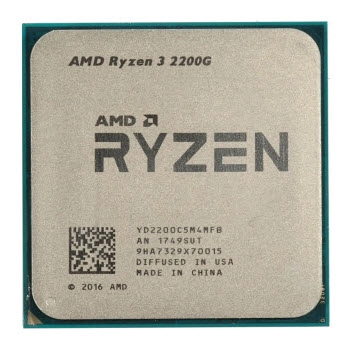
Tom's Hardware Verdict
The Ryzen 3 2200G a great deal for budget gaming rig builders and purchasing a single chip for both graphics and processing adds to the value.
Reasons to buy
- +
Price
- +
Higher frequencies
- +
Solid 720p gaming performance
- +
Unlocked multipliers
Reasons to avoid
- -
Eight lanes for PCIe slots
- -
Need to ensure motherboard BIOS compatibility
- -
Requires a better heatsink for overclocking
Why you can trust Tom's Hardware Our expert reviewers spend hours testing and comparing products and services so you can choose the best for you. Find out more about how we test.
Ryzen 3 2200G: Zen And Vega On The Cheap
AMD's Raven Ridge design combines Zen-based execution cores and the Vega graphics architecture into a highly integrated die complete with DDR4 memory control, PCI Express connectivity, north bridge functionality, and fixed-function accelerators. In our AMD Ryzen 5 2400G Review: Zen, Meet Vega, our expectations of integrated graphics were redefined, as Intel's UHD Graphics 630 succumbed without much of a fight. AMD's on-die graphics even did battle with certain sub-$100 discrete cards.
We do have to temper our excitement, though. These processors are mostly fit for playing games at entry-level detail settings using lower resolutions than a typical Tom's Hardware GPU review includes. Still, they boast impressive specifications. The flagship Ryzen 5 2400G earned our affections for its ability to play every game we tested at 1280x720. Some titles were even playable at higher-quality settings than we expected. Did we mention it overclocks well, too?
But we don't want to overlook the less expensive Ryzen 3 2200G, which at publication time made our list of best gaming CPUs and best CPUs for desktop applications. It includes four cores (without thread-doubling SMT technology) and eight Radeon Vega Compute Units (CUs). AMD aims this processor at an eSports crowd accepting of 720p gaming. Budget-oriented gamers will delight at its sub-$100 price point, easily in striking range of Intel's Pentium processors. Even though Pentiums now include Hyper-Threading, AMD justifies its premium with four physical cores and a much more capable graphics engine.
The Ryzen 3 2200G With Radeon Vega Graphics
Whereas the Ryzen 5 2400G comes with four SMT-enabled Zen cores and 11 Radeon Vega CUs, the Ryzen 3 2200G includes four cores without simultaneous multi-threading and eight CUs, enabling 512 Stream processors. Although Ryzen 3's resource allocation isn't far off from the flagship, it costs $70 less than Ryzen 5 2400G.
To further differentiate the two models, AMD lowers Ryzen 3's base clock rate to 3.5 GHz (though Precision Boost 2 allows frequencies as high as 3.7 GHz when headroom allows). Again, though, that's not particularly debilitating compared to Ryzen 5 2400G's 3.6 GHz base and 3.9 GHz Precision Boost frequency. Both processors also feature the same 4MB L3 cache. If you're interested in learning more about the Raven Ridge design, check out AMD Ryzen 5 2400G Review: Zen, Meet Vega.
Specifications
Ryzen 5 2400G and Ryzen 3 2200G both populate standard Socket AM4 interfaces on 300-series motherboards. All existing platforms include display outputs; just be sure your board of choice has the connectors you need. Existing motherboards need a firmware update to recognize the new models, while newer models include a "Ryzen Desktop 2000 Ready" badge indicating drop-in compatibility. Unfortunately, most online retailers fail to distinguish between them, so you might need a compatible processor to upgrade your motherboard until old inventory is sold off.
If you find yourself stranded, AMD does offer a "Boot Kit Solution" it says it'll ship to those in need. We don't have any information about what that kit includes, though.
Get Tom's Hardware's best news and in-depth reviews, straight to your inbox.
| Memory Support | Speed |
| 2 DIMMs - Single Rank | up to DDR4-2933 |
| 4 DIMMs - Single Rank | up to DDR4-2133 |
| 2 DIMMs - Dual Rank | up to DDR4-2667 |
| 4 DIMMs - Dual Rank | up to DDR4-1866 |
Ryzen 3 2200G, like Ryzen 5 2400G, includes unlocked ratio multipliers for overclocking. The graphics engine can naturally be tuned as well. A refined memory controller officially supports DDR4-2933 (up from DDR4-2666) for single-rank, dual-channel kits. It's purportedly more overclockable, too. Of course, memory support varies based on the type of memory and configuration you use, as outlined in the chart above. Shoot for the fastest setup possible; lower data rates hurt the bandwidth-hungry graphics engine.


As we discussed in our Ryzen 5 2400G review, the new Raven Ridge processors replace AMD's previous Ryzen 5 1400 and Ryzen 3 1200 models. These new chips support PCIe 3.0 connectivity, with four lanes dedicated to the chipset and four more that accommodate PCIe-based storage. An additional eight lanes are available for attaching discrete graphics. Unfortunately, that's a step backward from the outgoing Summit Ridge-based Ryzens that gave you 16 lanes for graphics. Then again, we don't expect anyone to run a multi-GPU config on an entry-level platform.
AMD also used Indium solder between the die and heat spreader of its Summit Ridge-based Ryzen CPUs. However, the company went with non-metallic thermal interface material for Ryzen 5 2400G and Ryzen 3 2200G. AMD bundles its 65W Wraith Stealth cooler with both models, and while the aluminum-core sink was designed for 65W processors, we recommend a beefier aftermarket cooler for overclocking. We covered Raven Ridge's thermal and power characteristics earlier this week. So now, let's see how Ryzen 3 2200G stacks up next to Intel's Pentium G4620.
MORE: Best Cheap CPUs
MORE: Intel & AMD Processor Hierarchy
MORE: All CPUs Content
Current page: Ryzen 3 2200G: Zen And Vega On The Cheap
Next Page Overclocking & Test Setup
Paul Alcorn is the Editor-in-Chief for Tom's Hardware US. He also writes news and reviews on CPUs, storage, and enterprise hardware.
-
wh3resmycar add mid/high 30 fps target for FC and witcher 3 and see if it can hold its own against a ps4. that would make more sense instead of playing it at 60 fps - low.Reply -
salgado18 "In the end, there's no way we'd recommend a Pentium's two physical cores over Ryzen 3 2200G's four. And the dead-end Z270 chipset does little to help Intel's case. Coffee Lake-based Pentium processors can't get here fast enough. Even then, though, it's a safe bet they won't arrive with on-die graphics capable of battling AMD's Radeon Vega."Reply
There, so you guys stop saying the G4560 is better. -
drinkingcola86 Did you run these processors with the standard bios or did you change the limit of the video side of it to 2 gig from the 512meg that it is defaulted to?Reply -
Shumok I would like to see the APU's tested with 1080ti's to see how they hold up when the user upgrades to discrete eventually.Reply -
nate1492 Reply20713408 said:"In the end, there's no way we'd recommend a Pentium's two physical cores over Ryzen 3 2200G's four. And the dead-end Z270 chipset does little to help Intel's case. Coffee Lake-based Pentium processors can't get here fast enough. Even then, though, it's a safe bet they won't arrive with on-die graphics capable of battling AMD's Radeon Vega."
There, so you guys stop saying the G4560 is better.
Would you really suggest the Ryzen 3 2200g or the Ryzen 5 2400g to someone over a G4560 and a 1050 (200 quid!)? Heck, take the AMD 1200 and the 1050, doesn't matter, I couldn't suggest gaming at low 720p to anyone, we are talking 90 quid, 140 quid, or 200 quid here. If you can't pony up 200 quid, just wait longer.
And at this price point, who is even considering upgrading CPUs in short order? -
logainofhades Reply20713566 said:Would you really suggest the Ryzen 3 2200g or the Ryzen 5 2400g to someone over a G4560 and a 1050 (200 quid!)? Heck, take the AMD 1200 and the 1050, doesn't matter, I couldn't suggest gaming at low 720p to anyone, we are talking 90 quid, 140 quid, or 200 quid here. If you can't pony up 200 quid, just wait longer.
And at this price point, who is even considering upgrading CPUs in short order?
US pricing is far different apparently. The cheapest 1050, on pcpartpicker, is $154.98.
The G4560 is a great chip, but is on a dead platform, and hyperthreading can only do so much.
@$99, the 2200g gets you in the door, for low budget gaming, and has enough horsepower to handle a midrange graphics card, once GPU prices get back to normal. Ram price difference isn't much different between the slower and higher clocked models, 3200 and lower. Also you have ability to go up to a higher cored Ryzen 5 or 7, if the need arises. Also current AM4 boards are supposed to be compatible with Ryzen II, with a bios update. With the Pentium G, you are stuck with a 7700k at best, and most likely will have a board that cannot even overclock it. A decently priced B350, on the other hand, can overclock.
AMD has the low end locked in, for now. Once coffee lake Pentiums and we get non Z chipset boards, the tables will probably turn, to some degree. That is the beauty of competition though, and that is a good thing. -
BulkZerker "Then again, we don't expect anyone to run a multi-GPU config on an entry-level platform."Reply
Cryptomining enthusiasts non-withstanding -
ghettogamer not an xbox one killer , but you can build a mini itx & get into pc gaming with this cpu for almost the same price albeit at 720p custom medium-low settings. This cpu is probably the power plant of the future ps5/xbox2, great for console fans!Reply -
AlistairAB Reply20713566 said:20713408 said:"In the end, there's no way we'd recommend a Pentium's two physical cores over Ryzen 3 2200G's four. And the dead-end Z270 chipset does little to help Intel's case. Coffee Lake-based Pentium processors can't get here fast enough. Even then, though, it's a safe bet they won't arrive with on-die graphics capable of battling AMD's Radeon Vega."
There, so you guys stop saying the G4560 is better.
Would you really suggest the Ryzen 3 2200g or the Ryzen 5 2400g to someone over a G4560 and a 1050 (200 quid!)? Heck, take the AMD 1200 and the 1050, doesn't matter, I couldn't suggest gaming at low 720p to anyone, we are talking 90 quid, 140 quid, or 200 quid here. If you can't pony up 200 quid, just wait longer.
And at this price point, who is even considering upgrading CPUs in short order?
-
AlistairAB Reply20713566 said:20713408 said:"In the end, there's no way we'd recommend a Pentium's two physical cores over Ryzen 3 2200G's four. And the dead-end Z270 chipset does little to help Intel's case. Coffee Lake-based Pentium processors can't get here fast enough. Even then, though, it's a safe bet they won't arrive with on-die graphics capable of battling AMD's Radeon Vega."
There, so you guys stop saying the G4560 is better.
Would you really suggest the Ryzen 3 2200g or the Ryzen 5 2400g to someone over a G4560 and a 1050 (200 quid!)? Heck, take the AMD 1200 and the 1050, doesn't matter, I couldn't suggest gaming at low 720p to anyone, we are talking 90 quid, 140 quid, or 200 quid here. If you can't pony up 200 quid, just wait longer.
And at this price point, who is even considering upgrading CPUs in short order?
The 2400G is 10 (single core) to 120 (multicore) percent faster as a CPU after a mild OC. It costs $275 for a G4560 and a GTX 1050 in Canada, much more than $210 for the Ryzen 2400G, which almost has GTX 1050 level graphics as it easily outperforms the gt 1030.
As for the 2200G, an extra $30 gets you a modern motherboard platform, a better cooler, more multi core performance, and easy upgrade-ability. Kind of funny criticizing it's lack of 1080p chops, when everything works perfectly at 900p. (Can't even play Overwatch at 360p properly with Intel integrated graphics).