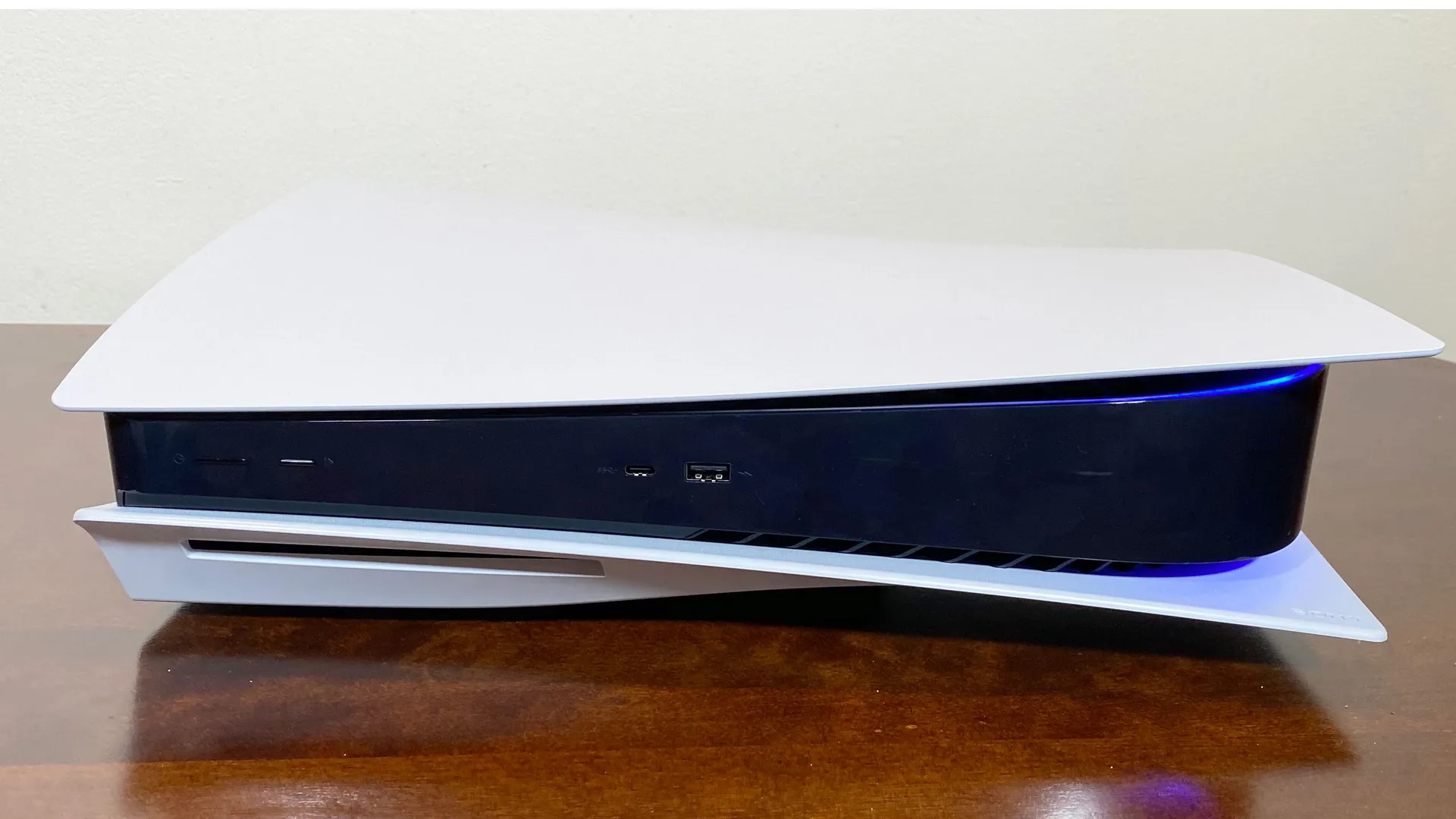
PS5 Linux loader goes public, turning ‘Phat’ consoles into full Linux PCs — build script includes bootable Ubuntu 24.04 image, can output 4K games at 60 FPS

PlayStation 5
(Image credit: Tom's Hardware)

Security engineer Andy Nguyen, known online as TheFlow, has publicly released ps5-linux on GitHub: a complete toolchain for booting Linux on PlayStation 5 Phat consoles running firmware versions 3.xx through 4.xx. The project, which Nguyen demonstrated running GTA V Enhanced Edition via a proof-of-concept in March, is now a documented, reproducible process that anyone with compatible hardware can follow.

The release includes a Linux payload that exploits a patched hypervisor vulnerability, a build script that produces a bootable Ubuntu 24.04 image, tools for M.2 SSD installation, and a fan and CPU/GPU boost control utility. Nguyen credits several contributors, including c0w, resulknad, flatz, and the fail0verflow and ps5-payload-dev teams.

Article continues below

Installing the payload requires a separate jailbreak tool — the umtx2 exploit — for initial code execution. Users set up a fake DNS server and HTTPS host on a local PC, redirect the PS5's manual page lookup to trigger the exploit, then send the ps5-linux-loader payload over TCP. After the console enters rest mode and the LED goes solid orange, pressing the power button boots into Linux. If the LED turns white, it worked.

Once booted, the PS5 runs as an x86 Linux desktop with access to all eight Zen 2 CPU cores (16 threads) at up to 3.5 GHz and the RDNA 2 GPU at up to 2.23 GHz. A bundled control tool enables CPU and GPU boost clocks alongside an adjustable fan curve, and Nguyen warns users should always enable the fan profile when boosting, as the console's cooling was designed for Sony's own power management. You can see the hack running GTA V in the tweet above.

The system outputs video and audio over HDMI at 1080p, 1440p, or 4K at 60 Hz. All USB ports remain functional, so users can optionally install Linux onto an M.2 SSD inserted in the PS5's expansion slot, turning it into a dedicated Linux partition separate from the console's internal storage. The internal SSD is never modified, and the console can return to normal PS5 operation on a standard reboot.

It’s worth noting that ps5-linux is a soft mod, not a permanent installation, meaning that the exploit must be re-run each time you want to boot into Linux. Some monitors are also known to have compatibility issues with HDMI output at 1440p and 4K, and Nguyen in his FAQs directs users to try a 1080p fallback or join the project’s Discord for troubleshooting.

With discrete GPU prices remaining elevated and Valve’s Steam Machine delayed beyond its original early 2026 expected launch window, a used PS5 Phat on old firmware could easily serve as an affordable and surprisingly capable alternative for Linux gamers willing to work through the setup.

Google Preferred Source

Follow Tom's Hardware on Google News, or add us as a preferred source, to get our latest news, analysis, & reviews in your feeds.

Luke James
Contributor

Luke James is a freelance writer and journalist.  Although his background is in legal, he has a personal interest in all things tech, especially hardware and microelectronics, and anything regulatory. 

  • usertests
    Users who want to downgrade or sideload a specific firmware version can do so using Sony's official reinstall process with the correct PUP file.
    Meaning that all PS5 consoles can now be turned into PCs (albeit with some remaining issues)?
    Reply
  • edman565
    usertests said:
    Meaning that all PS5 consoles can now be turned into PCs (albeit with some remaining issues)?
    Sounds like technically yes, but it's not trivial to boot into Linux if you have to jump through extra hoops every time you want to switch .
    Reply
  • atomicWAR
    I'd love to see Steam OS running on a PS5 personally.
    Reply
  • edman565
    atomicWAR said:
    I'd love to see Steam OS running on a PS5 personally.
    That would be awesome. Even Bazzite shouldn't be that difficult to get up and running.
    Reply
  • bit_user
    Bravo! The degree of refinement (i.e. how many console features & functions work properly) is truly impressive! This is much more than just a testbench achievement!

    To be honest, part of me isn't that interested. Aside from the GPU, it's not hard to find desktop mini PCs that offer better price/performance. If the PS5's GPU were more impressive, that could make it worthwhile, but it was fairly mid-range at launch and that was 5 years ago.

    By contrast, booting Linux on something like the PS3 could've been interesting for playing around with the Cell SPEs. The current (and previous gen) consoles are too much like PCs, to interest me on technical level.
    Reply
  • banananon
    usertests said:
    Meaning that all PS5 consoles can now be turned into PCs (albeit with some remaining issues)?
    PS5's cannot be downgraded. The writer's claim that they can be is false, and seems like they miscomprehended the GitHub readme. The PS4, for example, requires a microcontroller soldered directly to the eprom to downgrade.

    I hope the writer sees this and corrects the article.
    Reply
  • usertests
    bit_user said:
    To be honest, a small part of me isn't that interested. Aside from the GPU, it's not hard to find desktop mini PCs that offer better price/performance. If the PS5's GPU were more impressive, that could make it worthwhile, but it was fairly mid-range at launch and that was 5 years ago.
    Lessons can be learned from the BC-250, which was arguably worth the $50-100... maybe up to $150 that people were paying for it.

    The BC-250 doesn't include a case, PSU, or SSD, which all add to the cost, and I think it has less ports. It also has 2 of the CPU cores and a substantial amount of the GPU disabled (not just CUs, some aspect of it was cut in half IIRC).

    A used PS5 is ready to go. Tens of millions of people have them, and if they are sitting around unused and not being resold, there's now an opportunity to repurpose them into a fairly powerful mini PC (if they are using the correct firmware, see above comment).

    The 16 GB GDDR6 memory is not ideal, but it works. 8-core Zen 2 (with weak FPUs and low clocks) is not too impressive next to the cheapest Zen 4 mini PC you can find, but better than a Steam Deck. This story is talking about leaving the SSD alone, but if you can use that, a near-terabyte is more valuable than ever.
    Reply
  • bit_user
    usertests said:
    The 16 GB GDDR6 memory is not ideal, but it works. 8-core Zen 2 (with weak FPUs and low clocks) is not too impressive next to the cheapest Zen 4 mini PC you can find, but better than a Steam Deck. This story is talking about leaving the SSD alone, but if you can use that, a near-terabyte is more valuable than ever.
    16 GB should be more than enough for casual use.

    Same with that CPU. I see the weak FPU as a non-issue, since anyone who really cared about FPU performance wouldn't even be considering even a full 8-core Zen 2 APU.

    I'd agree that utilizing the integrated SSD would be a game-changer, in terms of the value proposition. That's the biggest issue with the mini-PC option, nowadays.
    Reply
  • usertests
    bit_user said:
    16 GB should be more than enough for casual use.
    I was thinking less of the capacity and more about the use of GDDR6. It can exhibit high latency, which isn't ideal for some PC applications. I recall some of the reviews of the 4700S desktop kit (PS5 board with GPU completely disabled) were critical due to this factor. The Tom's review covers it for the 4700S but was more focused on other aspects like the PCIe 2.0 x4 connection for the dGPU:

    https://www.tomshardware.com/reviews/amd-4700s-desktop-kit-review-ps5-cpu/4
    It's a tradeoff you can likely accept if you pulled a dusty PS5 out of the closet or can get one cheap on the used market. I see many of them going for $300+ on ebay, so maybe the value proposition is dubious.
    Reply
  • bit_user
    usertests said:
    I was thinking less of the capacity and more about the use of GDDR6. It can exhibit high latency, which isn't ideal for some PC applications. I recall some of the reviews of the 4700S desktop kit (PS5 board with GPU completely disabled) were critical due to this factor.
    High memory latency makes it less attractive than using Zen 2 APUs in an AM4 socket, but still a viable option for anything where someone would consider using a Ryzen 4800U-tier system.

    This test shows the PS5's GDDR6 latency is only a little worse than the Steam Deck's LPDDR5 latency:

    Source: https://chipsandcheese.com/p/the-nerfed-fpu-in-ps5s-zen-2-cores
    To put that in perspective,
    Source: https://chipsandcheese.com/p/amds-chiplet-apu-an-overview-of-strix

    usertests said:
    It's a tradeoff you can likely accept if you pulled a dusty PS5 out of the closet or can get one cheap on the used market. I see many of them going for $300+ on ebay, so maybe the value proposition is dubious.
    Yeah, price is a big determining factor. Unless they can reuse the onboard storage, I think the value proposition really hinges on whether you need better GPU performance than a typical APU can provide.
    Reply