









ChatGPT-6 Astra cracks 85-year-old 1941 Enigma-coded message in two days — autonomous AI coded its own simulator to crack code that was unsolved since it was shared online back in 2005
Before it started cracking, the LLM developed Python and C++ software for an Enigma simulator and Enigma Bombe.

A German Army Enigma transmission from 85 years ago, known as the MVUEH message, has been cracked by GTP-Astra in two days, reports the Crypto Cella. MVUEH was sent by the German Army to the SS-Totenkopf (Death’s Head) Division on July 10, 1941, at the height of the Nazi military power in WWII. This uncracked Enigma message was shared with enthusiasts online in 2005, but its secrets had remained concealed until now.
Crypto Cellar researchers highlight that what Astra managed to do in just two days “would take a human researcher weeks or even months.” Currently, the awestruck researchers are still picking through logs to determine how Astra managed this feat and how it did it so quickly.
One of the most impressive things about Astra’s tackling of MVUEH was that it “did it entirely on its own,” says the source. It was merely asked whether it could break any of the unbroken Enigma machine messages published on the Crypto Cellar Research web page. In response, Astra picked Nr. 172, MVUEH as a promising target and thought it might be related to the plaintext of Nr. 173, SIPVX.
With its target decided and expecting the repeated place name "ROSENOW ROSENOW" as a probable plaintext clue, Astra developed Python and C++ software for an Enigma simulator and an Enigma Bombe. Its hunch appears to have been correct. You can see a demo of the radio message being decrypted online at the MVUEHA Cryptanalysis Case Study site (screenshot below).
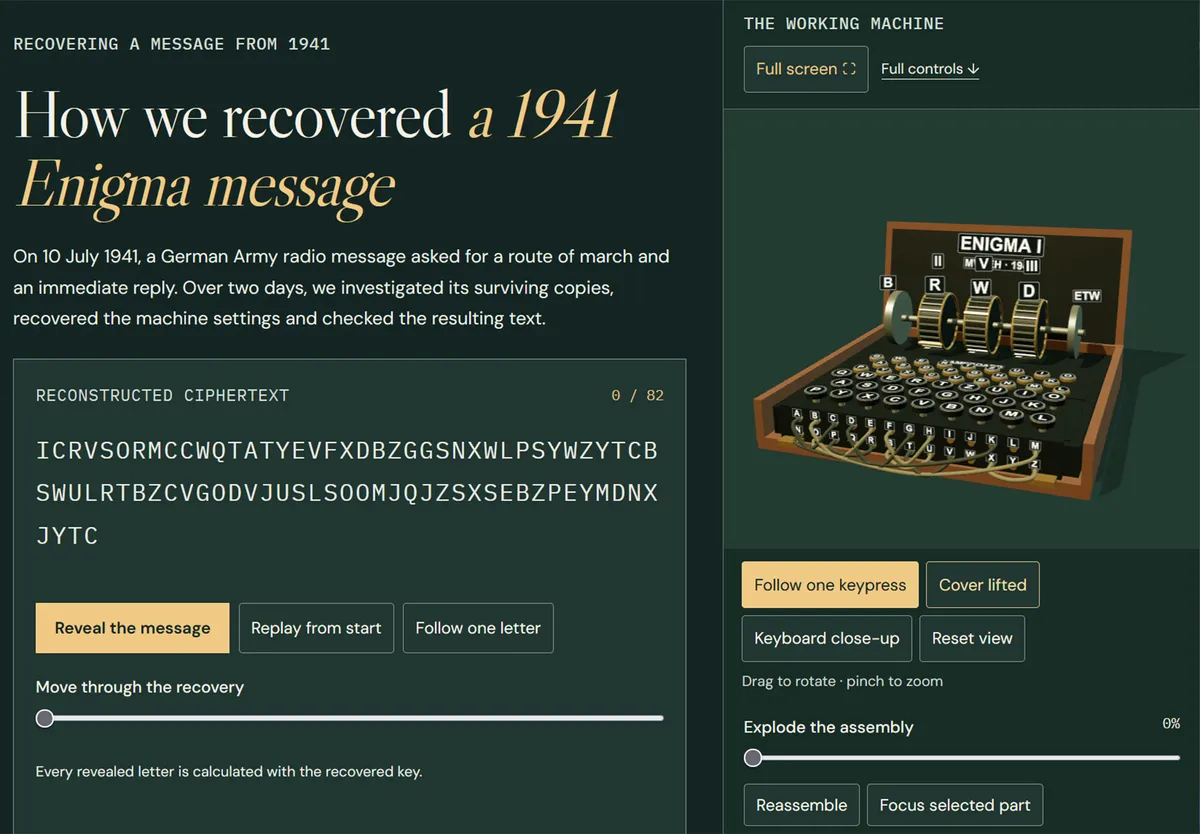
In brief, the encrypted 82-letter MVUEH cipher looked like this:
ICRVSORMCCWQTATYEVFXDBZGGSNXWLPSYWZYTCBSWULRTBZCVGODVJUSLSOOMJQJZSXSEBZPEYMDNXJYTC
Decrypted, with spaces added as appropriate, it looks like this:
BTTE UM ANGABE DES MARSQWEGES X BEFINDE MIQ IN X ROSENOW ROSENOW X SOFORT FUNKANTWORT X WASCHBBSCH
An approximate English translation is:
Please specify the route of march. I am in Rosenow, Rosenow. Immediate reply by radio
Get Tom's Hardware's best news and in-depth reviews, straight to your inbox.
Note that there was a spelling mistake at the front of the original message, which wouldn’t help decoding efforts.
We’ve looked at Enigma machines before, as efforts to crack wartime ciphers from them, as well as from Lorenz machines, would lead to some of the first general-purpose digital computer designs.
The Enigma featured a 26-key keyboard, with 26 light-up letters on the ‘lampboard’ positioned above it. Behind the lampboard, three rotors were installed from a set of five. The signal from a keyboard press traveled through an input wheel, then the three manually turnable rotors with 26 pins each, then a reflector to return the signal, which lit up the lampboard. Making it even more tricky to crack, the rotors would advance every keypress. Thus, if you keep pressing the same letter, a different letter on the lampboard would be shown each time. Yet another layer of obfuscation was added via the plugboard at the front of the machine, where users swapped more letters around. Operators used up to 10 plugboard rerouting wires.
Before using the Enigma machine, four settings must be dialed in by the operator: rotor order, ring setting, rotor starting positions, and plugboard connection(s). These settings were distributed separately, and they changed following a calendar. Even if the enemy had an Enigma machine, they’d also need to know the settings on the day to decode the message(s).
We reported on GPT6-Astra's deciphering skills just last week. The LLM was behind the cracking of a 108-year-old unsolved WWI German code that had been encrypted using the ADFGVX method.

Follow Tom's Hardware on Google News, or add us as a preferred source, to get our latest news, analysis, & reviews in your feeds.

Mark Tyson is a news editor at Tom's Hardware. He enjoys covering the full breadth of PC tech; from business and semiconductor design to products approaching the edge of reason.
-
evilpaul I'm not a cryptographer, but could they have tried asking the Germans? I bet somebody would know.Reply -
jeremyj_83 I remember seeing a video maybe 10 years ago by a computer scientist and breaking Enigma. They coded a program (I think in C++ or Java) that did a brute force method to breaking the encryption. Using nothing more than a midrange laptop with an i5-4200u the program was able to break a 1940 era Enigma (3 roters out of 5 choices) in several minutes. I guess the amazing thing was ChatGPT wrote a program? Thing is a lot of people use AI to do the initial code creation now anyways. IMO this message has probably been cracked multiple times but people didn't care.Reply -
derekullo Reply
You don't really need to crack it ... I'm sure some one kept the code book logs of what the enigma settings were for each day.jeremyj_83 said:I remember seeing a video maybe 10 years ago by a computer scientist and breaking Enigma. They coded a program (I think in C++ or Java) that did a brute force method to breaking the encryption. Using nothing more than a midrange laptop with an i5-4200u the program was able to break a 1940 era Enigma (3 roters out of 5 choices) in several minutes. I guess the amazing thing was ChatGPT wrote a program? Thing is a lot of people use AI to do the initial code creation now anyways. IMO this message has probably been cracked multiple times but people didn't care.
Here's April 1940's codes
https://www.101computing.net/wp/wp-content/uploads/enigma-code-book.pngThe Enigma machine was used between 1939 - 1945 during WW2.
As long as you know the day a message was sent/encrypted a 2190 line excel file could contain all of the settings for the rotor order, ring setting, rotor starting positions, and plug-board connections to decrypt any message you want.
Even without knowing the day a message was sent modern computers could just try every day's settings in a few milliseconds and decrypt it. -
Air2004 Reply
Now, that there's funny 😂😂🤣🤣🤣Admin said:A German Army Enigma transmission from 85 years ago, known as the MVUEH message, has been cracked by GTP-Astra in just two days.
ChatGPT-6 Astra cracks 1941 Enigma-coded message in two days : Read more
(Thank you for that) -
derekullo Reply
What makes you think AI isn't being used for cancer research?Joey2121 said:Now could we focus on cancer research using AI please?
Just because a historian is familiar with using AI for cryptology doesn't mean he has also the medical background to instantly pivot to cancer research.
I'm pretty good with creating prompts with Gemini along with using Hashcat and JackTheRipper, but I wouldn't even know what questions to ask for cancer research.