









Portable 40mm launcher kills drones by firing 6.5-feet-long steel chains at 80 m/s — German researchers' low-tech mechanical 'bola' outshines textile, drops quadcopters without lasers or EMPs
Forget lasers, just fire a chain at them.
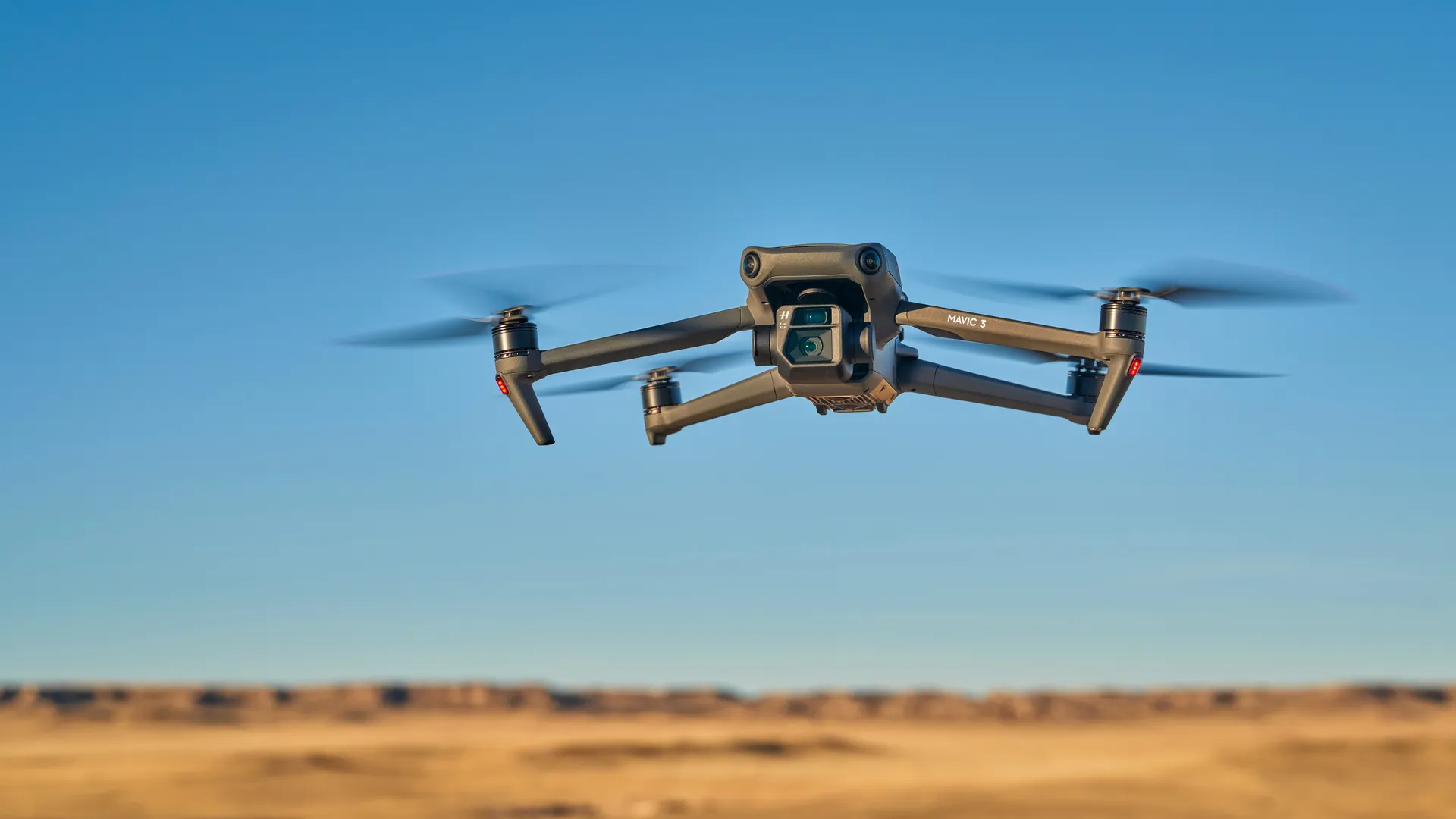
Researchers at Germany's Karlsruhe Institute of Technology (KIT) have published a study proposing a purely mechanical anti-drone weapon that fires thin steel chains at drones, entangling their rotors and knocking them out of the sky.
The work, led by Professor Claus Mattheck at KIT's Institute for Applied Materials and published in the journals Aerospace & Defence and Konstruktionspraxis, comes as Germany grapples with a surge in unauthorized drone flights over critical infrastructure.
The concept draws on the same physics as the bola, a weighted throwing weapon used for centuries by South American herders to bring down livestock and game. Rather than weighted cords, the KIT team uses lightweight metal chains with link diameters of three to four millimeters, fired from a 40mm caliber launcher at 80 m/s. On contact with a drone, the chain coils around the airframe and propeller blades, locking the rotors and dropping the aircraft.
The team modeled chain-on-drone impacts using the commercial finite element analysis Abaqus, simulating a 70-gram chain measuring 2,000mm in length striking a 1 kg model quadcopter. The simulations accounted for friction between the steel chain and the drone body, propeller geometry, and rotational dynamics.
Three scenarios were tested: a horizontally approaching chain hitting a stationary hovering drone, the same scenario using a chain launched from the 40mm tube, and a third variant where the drone was tilted 30 degrees and moving at 25 m/s.
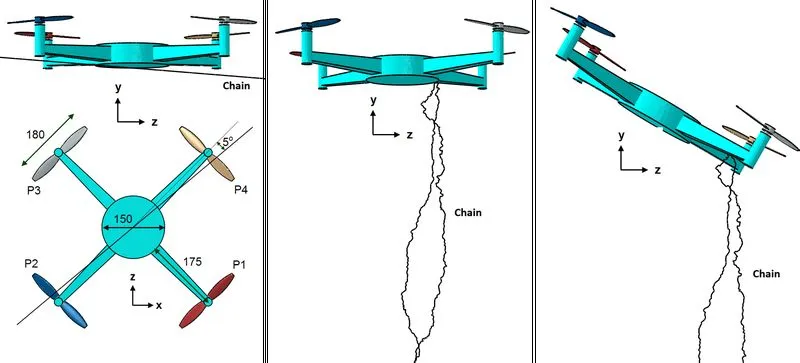
Mattheck's team also conducted live firing trials at the Sternenfels ballistics center in Baden-Württemberg using a catapult-based launcher. Though these were designed as basic viability tests, the researchers noted that they didn’t factor air resistance into their computational models, meaning that the ring vortex generated at the launcher’s muzzle could affect how the chain spreads after firing.
Firing chains at drones is the polar opposite of other anti-drone tech we’ve seen in recent months, such as directed-energy and electronic warfare systems. The UK's DragonFire laser, scheduled for installation on Royal Navy destroyers by 2027, uses a 50 kW fiber-combined beam to burn through targets at the speed of light.
Get Tom's Hardware's best news and in-depth reviews, straight to your inbox.
That costs thousands of dollars and requires substantial power infrastructure, while the KIT team's chain projectile weighs 70 grams and can be fired from a portable launcher. Mattheck noted that a falling chain poses less risk of collateral damage than a solid projectile of equal mass, and that the steel chain outperformed textile nets in initial catapult-based range tests. The biggest tradeoff is range: like a shotgun, the system is only effective at short distances.
Germany recorded over 1,000 suspicious drone flights above military facilities, airports, and other critical infrastructure in 2025 alone, according to senior security officials. Munich Airport was shut down multiple times due to unidentified drone activity last October, and the Bundestag has approved more than 100 million euros ($116 million) in counter-drone funding for 2025 and 2026 in response.

Follow Tom's Hardware on Google News, or add us as a preferred source, to get our latest news, analysis, & reviews in your feeds.

Luke James is a freelance writer and journalist. Although his background is in legal, he has a personal interest in all things tech, especially hardware and microelectronics, and anything regulatory.
-
Notton Looking at the broader picture, I don't think this will work well as a system at an airport.Reply
Judging by the 80m/s launch speed, I'm guessing it's the 40x46mm low-velocity
cartridge used by handheld grenade launchers...
That thing has a maximum range of 400m on an area target.
I'll be generous and give it 150m range on a flying target.
So a perimeter security is supposed to do what? drive sneakily within 150m of the drone, and take a single highly skilled shot at it to down it?
Do they have an army of Legolas' sitting withing their ranks?
Or is the intention to mount a custom H&K GMG for LV rounds onto a technical? -
PEnns I guess nobody told the researches about swarm drones. What country sends a single drone these days?Reply
Unless they want to swarm the swarm! -
USAFRet Reply
The short range is directly addressed in the article.Notton said:Looking at the broader picture, I don't think this will work well as a system at an airport.
Judging by the 80m/s launch speed, I'm guessing it's the 40x46mm low-velocity
cartridge used by handheld grenade launchers...
That thing has a maximum range of 400m on an area target.
I'll be generous and give it 150m range on a flying target.
So a perimeter security is supposed to do what? drive sneakily within 150m of the drone, and take a single highly skilled shot at it to down it?
Do they have an army of Legolas' sitting withing their ranks?
Or is the intention to mount a custom H&K GMG for LV rounds onto a technical?
Not every solution is good for every circumstance. -
justrudi Good thinking, chains could work but only if does not require to carry additional weapon whole day. Currently, Ukrainian teams have at least one pump action to disable drones. If the new ammo is simple to use as a pump action, it is a big solution for a current warfare stage.Reply -
MJS WARLORD Could be used to bring down drones flying near places such as airports or security sensitive locations.Reply
Not practical in a warfare situation , think of it like this , you could use a small chain to bring down a drone with explosives on it or a megga chain to bring down an F15.
You would still have a problem .... the payload be it large or small would still explode and do damage when it crashed to the ground.