









Notepad++ creator threatens legal action over macOS port of open-source app — developer says port is fine, but branding is too far
The app is still live despite a Cloudflare trademark complaint.
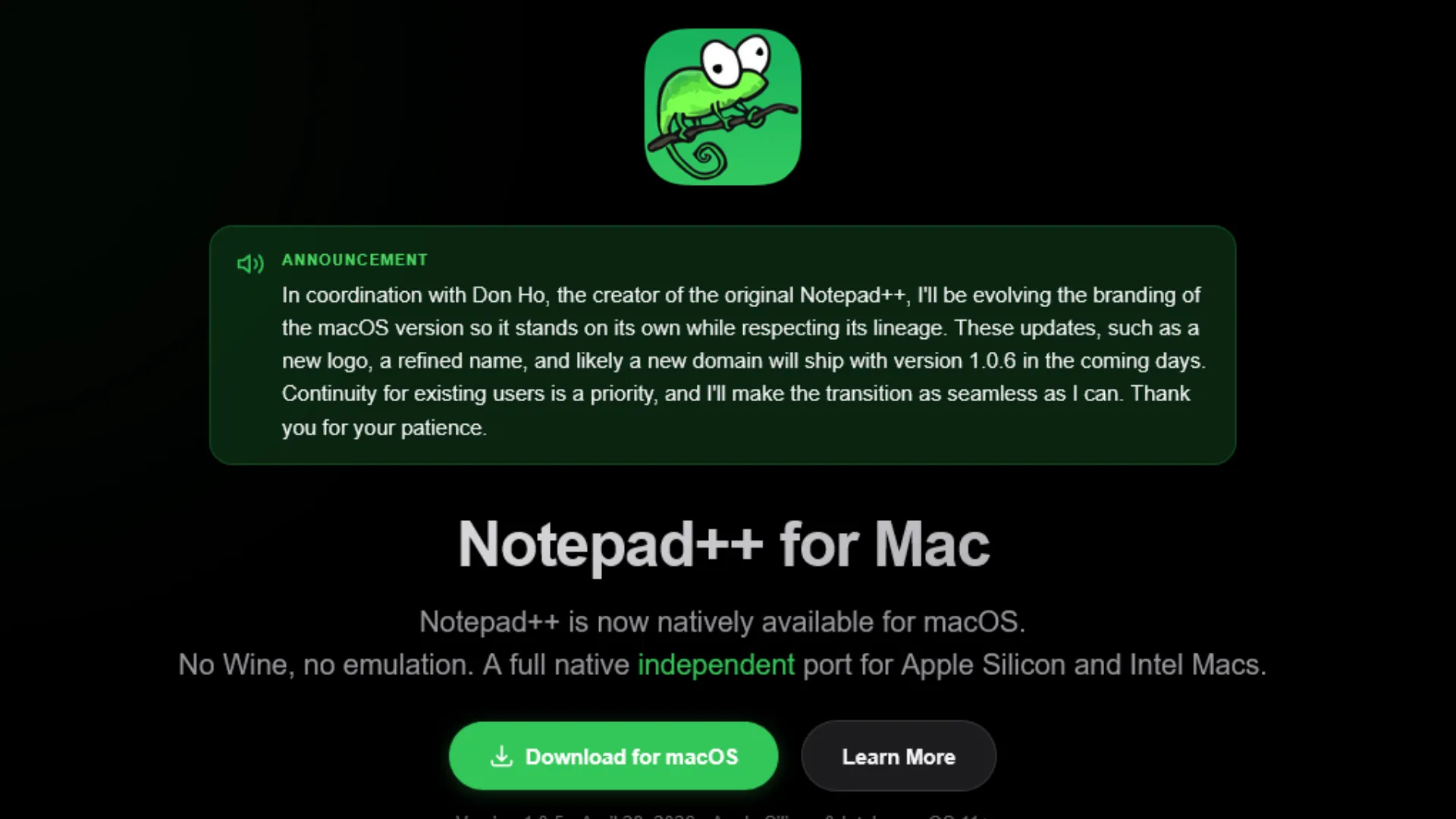
Notepad++ creator Don Ho has filed a trademark complaint with Cloudflare and is threatening further legal action against the developer of a macOS port that used the editor's name, logo, and even Ho's own biography to present itself as an official release. Ho published a blog post on May 1st calling the project a "fake" and asking users to help correct the record online.
The macOS port, built by New York-based developer Andrey Letov using AI-assisted development workflows, launched its first public version in April and quickly attracted attention from tech outlets that covered it as if it were an official cross-platform expansion of the 22-year-old Windows text editor.
Several publications initially reported the port as a long-awaited native release before correcting their coverage after Ho's blog post. The project's website used the Notepad++ chameleon logo, a near-identical domain name, and an author page that listed Ho alongside Letov without Ho's knowledge or consent. A disclaimer noting the port was independent appeared on the site, but required scrolling past the marketing copy to find.
In a GitHub thread where the early dispute played out (and is still ongoing,) Ho argued that it’s “risky for the Notepad++ team to appear as endorsing any project which claims to be based on the Notepad++ code base,” with other contributors arguing that such actions could expose users to malware and that any security problems in the port would damage the reputation of the original project.
That potential damage to reputation is doubtless a genuine concern for Ho, too, when back in February, Notepad++ announced that its own update server had been hijacked in a targeted supply chain attack linked to the Chinese espionage group Lotus Blossom. That attack delivered trojanized installers to a subset of users through the editor's built-in updater for roughly seven months.
Ho has spent the months since tightening update verification, and an unauthorized fork trading on the same brand identity complicates that effort and makes it harder for users to distinguish legitimate software from imitations.
He has stressed that his issue isn’t with the macOS port — indeed, Ho has expressed how he’s happy to see a macOS port — but the unauthorized use of branding; Notepad++ is released under the GPL v3, which permits anyone to fork and modify the source. The project's name and logo, however, are trademarked, and Ho didn’t grant permission for either to be used. Letov responded to the initial complaint by expressing hope that Ho would endorse the port, but Ho refused, per reporting from The Register, saying he would not put his name on software he doesn’t manage.
Get Tom's Hardware's best news and in-depth reviews, straight to your inbox.
Letov then added a banner to the macOS port's website claiming the rebranding would happen "in coordination with Don Ho." Ho told The Register that no such coordination exists and that he has asked Letov to take the site down immediately. Letov requested a couple of weeks to transition to the new branding and a new domain, but Ho rejected this timeline, citing the continued risk of trademark infringement.
As of the time of publication, the macOS port's website remains live under the same domain but with the name “Nextpad++ for Mac,” and its own frog sprite logo.

Follow Tom's Hardware on Google News, or add us as a preferred source, to get our latest news, analysis, & reviews in your feeds.

Luke James is a freelance writer and journalist. Although his background is in legal, he has a personal interest in all things tech, especially hardware and microelectronics, and anything regulatory.
-
GenericUser2001 It seems that the Notepad++ creator is fully in the right here; it is completely reasonable that he does not want his name, or the main project name, attached to a port he is not actually involved with. Preventing confusion on who is creating what is exactly what trademark law is for.Reply -
spadoop If I were Ho, I'd do the same, if not more and sooner. This Letov joker is obviously still trying to use Ho's name for a veneer of authenticity while playing innocent.Reply
Like, the original issue of using the logo, name, etc could be waved away as well-intentioned but naive. But the follow-up, where Letov is simultaneously dragging his feet while claiming coordination with Ho where none exists? Especially after Notepad++'s recent ordeal with hijacked updates? It screams either malice or deep deep stupidity, neither of which Ho would want anywhere near him or Notepad++. -
evermorex76 Just a question about open source software in general that maybe applies here. If someone does a port of your project, doing nothing but letting AI tools change what needs to be changed, and in the future does nothing but take the code for each update you publish and run it through the AI tools again, with no changes other than making it run on another OS, is that covered under the licensing? Or even if they actually do the work themselves, again not making any changes to functions or features or fixing any bugs, just porting? Is it considered creative modification that makes it a different piece of software or is it just a conversion but still the same application? If it's still the same software, is there a commonly accepted (or defined in licenses), measurable threshold that makes it different?Reply -
chaos215bar2 Reply
Any AI involvement here is completely irrelevant to the question of trademark infringement.evermorex76 said:Just a question about open source software in general that maybe applies here. If someone does a port of your project, doing nothing but letting AI tools change what needs to be changed, and in the future does nothing but take the code for each update you publish and run it through the AI tools again, with no changes other than making it run on another OS, is that covered under the licensing? Or even if they actually do the work themselves, again not making any changes to functions or features or fixing any bugs, just porting? Is it considered creative modification that makes it a different piece of software or is it just a conversion but still the same application? If it's still the same software, is there a commonly accepted (or defined in licenses), measurable threshold that makes it different?
The port is not done in association with the original project and does not have permission to use the name or logo of the original. OSS licensing covers source code. It does not give anyone permission to impersonate trademarks associated with a project they do not own.
And regardless, AI is not just some magic black box you get to put a project through while somehow claiming it's a neutral representation of the original project's intent. That's a complete misunderstanding of how these tools work.
This port is an entirely new project. Presumably Notepad++'s license allows its source to be used in this manner, but the resulting work is no longer "Notepad++" unless the owner of that trademark says it is. -
etoven Ow they do this c**p all the time .The entire os is nothing but a hodge podge of rebranded open projects. Its quite frankly discusting. So happy to see them take a stand for once.Reply -
Terry Lambert Today he has only registered the image as a trademark in France, and the name as a trademark in France.Reply
The infringement only exists in France.
You will know from his blog post on which he commented on the original issue, that the issue has, in fact, now been resolved, and that this is no longer a story.
I think it is perfectly right to credit him as one of the authors, although I would suggest that the primary porting author should be listed first, as it is a derivative work.
I think it’s something of an overreaction, given that the updater for the software on his own site was compromised for a period of about seven months, and was installing Trojans on the machines of targeted users, during that entire time.
He has made a very large fuss about this particular violation of his French trademark, but he has not made a similarly large fuss in the press, notifying users of his product during the period of time that it was regent that they may in fact be infected with malware because of his product.
I think it is problematic. When someone uses the Linux name, they are actually also utilizing a trademark. Unlike Notepad++, that trademark is internationally registered, and the rules for its use are clearly stated.
While I understand that he would not want the confusion of it being an official release, given that he has consistently refused to release a macOS version of his open source project on his own site (which would’ve been problematic while the Trojan was still being distributed), it should be expected that someone would have done it eventually, particularly if he was not accepting the patches back into the project.
It’s troubling that the trademark on a GPLV3 product, given the GPL V3 actually has anti-intellectual property clauses for patents, would utilize intellectual property, such as a trademark, in this fashion.
However, this “do as I say, not as I do” aspect of GPLV3 has always been problematic for me.
Which should really happen if he should release an official port to macOS. It’s not like the code in the derivative work is not also GPL V3, because of the viral nature of GPL V3, so it’s not like you can’t demand the source code back.
So it’s not like he doesn’t have the source code for a fully functional macOS port of the product, or at least does not potentially have the source code.
Going forward, it would be nice if he were a bit more forthright about accepting patches from third parties. -
bit_user Reply
The article says the source code is licensed under GPLv3, which allows anyone to take the code, modify it, and re-release it. The only restriction is that you must also release any derivative work under GPLv3 (or a successor).evermorex76 said:Just a question about open source software in general that maybe applies here. If someone does a port of your project,
The issue centers around trademark infringement (i.e. the name & logo). Those aren't covered by the GPLv3 license.
The derivative work can acknowledge that it was based on the Notepad++ source code, but it can't pretend to be an official MacOS port of Notpad++.
To get some insight into why he cares, imagine this port is buggy or has a backdoor. Think of the reputational damage that could do to the original creator, even though he had nothing to do with it! -
bit_user Reply
The Notepad++ creator said he was actually glad to see the port, but he just doesn't want to be seen as endorsing or otherwise involved in it.etoven said:Ow they do this c**p all the time .The entire os is nothing but a hodge podge of rebranded open projects. Its quite frankly discusting. So happy to see them take a stand for once. -
bit_user Reply
Since most probably won't get the reference, NeXT Computer (where Steve Jobs went, in between his two stints at Apple) famously adopted and popularized a programming language called Objective C, which could be seen as sort of like a C++ alternative. Jobs' return to Apple came via their acquisition of NeXT, and its technology would form the basis for OS X.rezonant said:They should call it Objective Notepad. 🥁