









Bolt Graphics tapes out its first Zeus GPU test chip on TSMC 12nm — firm touts 17x lower cost of compute
From simulation to silicon.
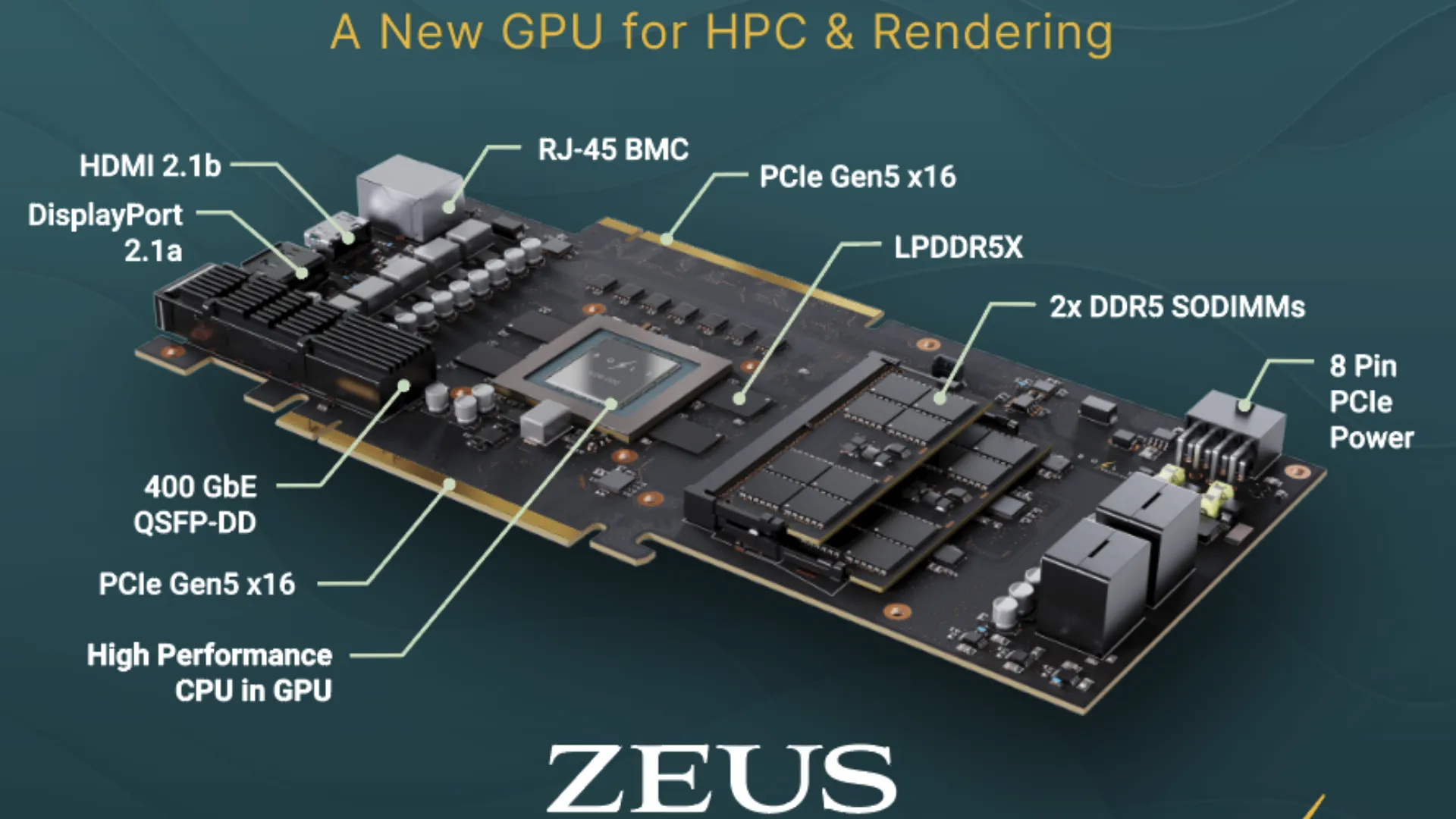
Bolt Graphics has announced its completed tape-out of a test chip for its Zeus GPU, marking the California-based startup's first move from FPGA emulation to manufactured silicon — which it claims can deliver 17 times lower cost of compute.
The test chip was designed into TSMC's 12nm FFC process and will be used for customer benchmarking ahead of a planned production ramp in Q4 2027. Bolt says it’s targeting companies in the HPC, electromagnetic simulation, and graphics rendering markets, which it values at over $55 billion combined, that "can’t afford the level of compute needed for their applications."
This is a concrete step for a company whose ambitious performance claims have, until now, rested entirely on internal simulations and FPGA testing. When Bolt first introduced Zeus in early 2025, it said the GPU could deliver up to 10 times the path tracing throughput of Nvidia's GeForce RTX 5090. Those figures obviously drew attention as well as skepticism, given the absence of working silicon. In a set of FAQs released alongside the announcement, Bolt says that its architecture has been running on FPGA and under evaluation by customers for four years.
TSMC’s 12nm FFC node is part of the company’s mature 16nm/12nm FinFET family, offering lower cost and well-established IP libraries compared to leading-edge processes. According to Bolt, however, the Zeus architecture is also designed for "advanced nodes, including 5nm," suggesting the 12nm test chip is more of a validation step and that the company will look to use more advanced nodes for final production.
According to Bolt’s product specs, Zeus will ship in PCIe card and 2U server form factors. The PCIe cards range from a single-slot, 120 W model with 5/10/20 TFLOPS at FP64/FP32/FP16, up to a dual-slot, 250 W card offering twice those figures. All cards feature 128 MB to 256 MB of on-chip cache, up to 384 GB of memory through a combination of soldered LPDDR5X and DDR5 SO-DIMMs, and integrated 400 GbE networking.
| Row 0 - Cell 0 | Bolt Zeus 1c26-032 |
Bolt Zeus 2c26-064 |
Bolt Zeus 2x26-128 |
Form factor |
Single-slot PCIe |
Dual-slot PCIe |
Dual-slot PCIe |
Board power |
120 W |
250 W |
250 W |
FP64/FP32/FP16 vector TFLOPS |
5/10/20 |
10/20/40 |
10/20/40 |
INT16/INT8 matrix TFLOPS |
307.2/614.4 |
614.4/1,228.8 |
614.4/1,228.8 |
On-chip cache |
128 MB |
256 MB |
256 MB |
Memory |
Up to 160 GB, 32 GB LPDDR5X, 2x DDR5 SO-DIMMs |
Up to 320 GB, 64 GB LPDDR5X, 4x DDR5 SO-DIMMs |
Up to 384 GB, 128 GB LPDDR5X, 4x DDR5 SO-DIMMs |
Bolt's stated product pipeline exceeds $500 million, and the company says over 14,000 enterprises, developers, and end users have joined its early access program. It closed a Series A that was reportedly 50% oversubscribed, though neither the funding amount nor lead investors have been disclosed.
Timelines have shifted somewhat since Bolt first appeared on the scene, with the company originally aiming for developer kits in late 2025 and production in late 2026. At CES in January, the company demoed a prototype card but still lacked functional silicon. This new announcement pins production to Q4 2027 to supply chains for HPC, rendering, and next-gen workloads, with no updated timeline for developer hardware.

Follow Tom's Hardware on Google News, or add us as a preferred source, to get our latest news, analysis, & reviews in your feeds.
Get Tom's Hardware's best news and in-depth reviews, straight to your inbox.

Luke James is a freelance writer and journalist. Although his background is in legal, he has a personal interest in all things tech, especially hardware and microelectronics, and anything regulatory.
-
IntelUser2000 GPU based on open source? I'm all for it.Reply
But don't expect a 12nm chip to be significantly faster if it moves to say 5nm. When people say Moore's Law is dying, they mean that traditional just porting to new node and benefitting era is gone. It requires significant work to get the full advantages of a new node. Nvidia/AMD has already done the hard work and know this. It's very unlikely a startup can take full advantage of the newer nodes like established players do.
Even if you have a potential winner, the actual winner is determined by the details, such as optimizing and fine tuning the thing. And of course timing is important as fine tuning and optimization is potentially half the work, and can throw off your schedule.
Oftentimes the "traditional" ones continue on because they keep making new products like clockwork, whereas a startup's advantages are lost due to delays, which Bolt graphics is already suffering with the delay to 2027. -
bit_user The article seems to lack a source link. I'm guessing it's based on this press release:Reply
https://www.prnewswire.com/news-releases/bolt-graphics-completes-tape-out-of-test-chip-for-its-high-performance-zeus-gpu-a-major-milestone-in-reducing-computing-costs-by-17x-302750442.html
Huh? Specifically what is the "open source" claim and where did you see it?IntelUser2000 said:GPU based on open source? I'm all for it.
Nvidia's RTX 2000 was built on a 12nm node; RTX 4000 was built on a N5-family node. Want to guess which one is faster?IntelUser2000 said:But don't expect a 12nm chip to be significantly faster if it moves to say 5nm.
It's obviously not going to be the exact same chip on N5 that they're taping out out 12 nm. The 5 nm version will certainly be scaled up and running at higher clock speeds.
Yeah, time-to-market is a serial killer of promising chip startups. By the time Bolt gets a chip to market that's on a remotely competitive node, they'll have missed their market window. Even if their current tech is competitive against a RTX 5090, their final production silicon will have to face a RTX 6090 (or later).IntelUser2000 said:Even if you have a potential winner, the actual winner is determined by the details, such as optimizing and fine tuning the thing. And of course timing is important as fine tuning and optimization is potentially half the work, and can throw off your schedule.
Oftentimes the "traditional" ones continue on because they keep making new products like clockwork, whereas a startup's advantages are lost due to delays, which Bolt graphics is already suffering with the delay to 2027.
Same story repeats itself over and over. That's why it's so hard to displace the big CPU and GPU makers. -
thestryker Reply
Honestly they're fine (with this timeline) for the market they're aiming at. There's no chance nvidia is going to design anything to compete as long as the ai money is flowing. I think the biggest problem they're facing (at least on the non-HPC markets) is going to be the software side of things. For example with rendering it wouldn't matter if they were double the speed of whatever is released at the time without rock solid software.bit_user said:Yeah, time-to-market is a serial killer of promising chip startups. By the time Bolt gets a chip to market that's on a remotely competitive node, they'll have missed their market window. Even if their current tech is competitive against a RTX 5090, their final production silicon will have to face a RTX 6090 (or later).
None of this is to say that sooner isn't better, because it absolutely is, just that their niche is pretty safe as long as they don't stumble. -
bit_user Reply
Nvidia will eventually release RTX 6090 (and the corresponding workstation cards). Contrary to popular belief, Nvidia hasn't stopped development on non-AI software. Last year, they updated their non-realtime raytracing library to take advantage of the Shader Execution Reordering (SER) in the RTX 5090:thestryker said:Honestly they're fine for the market they're aiming at. There's no chance nvidia is going to design anything to compete as long as the ai money is flowing.
https://developer.nvidia.com/rtx/ray-tracing/optix -
thestryker Reply
Do you really think the 6090 is going to have a minimum double the RT capability of the 5090? I sure don't. There's too many other things that nvidia needs their parts to do that Bolt isn't even looking at.bit_user said:Nvidia will eventually release RTX 6090 (and the corresponding workstation cards). -
bit_user Reply
Sure, I could see they pulling out another 2x in RT performance, between efficiency enhancements, frequency, and more SMs. Don't forget that they'll be on a new node.thestryker said:Do you really think the 6090 is going to have a minimum double the RT capability of the 5090? I sure don't.
Also, they're continuing to enhance ReSTIR:
https://research.nvidia.com/labs/rtr/publication/lin2026restirptenhanced/
They're a big company. They can walk and chew gum, at the same time. Now that they have Groq, they aren't as dependent on their client GPUs for inference acceleration.thestryker said:There's too many other things that nvidia needs their parts to do that Bolt isn't even looking at.
https://www.nvidia.com/en-us/data-center/lpx/ -
thestryker Reply
Yeah I know that's why I said 2x instead of more.bit_user said:Also, they're continuing to enhance ReSTIR
That would be a first since Turing to Ampere, but I like your optimism.bit_user said:Sure, I could see they pulling out another 2x in RT performance, between efficiency enhancements, frequency, and more SMs. Don't forget that they'll be on a new node. -
bit_user Reply
No, both Ada and Blackwell had further improvements to the RT cores.thestryker said:That would be a first since Turing to Ampere, but I like your optimism.
That's why Nvidia still leads on RT performance, in spite of all RDNA4's improvements, here. I'm sure they're not done, yet. -
thestryker Reply
Of course they did, and I didn't say any different. I said they didn't improve them as much as that first gen on gen.bit_user said:No, both Ada and Blackwell had further improvements to the RT cores.
If you look at relative performance in games the 3090 Ti sits between the 4070 Ti and 4070 Ti Super in raster/rt/pt and has ~1/3 more RT cores. It's somewhat hard to mix in the 50 series to that comparison because the 5070 is slower and has even fewer RT cores and the 5070 Ti is a lot faster card. Comparing the 4080 and 5070 Ti though has the two very close in raster, and the gap is slightly larger in rt/pt but close enough I think it's fair to call it the same there too. The 4080 has ~8.5% more RT cores so there's definitely an improvement on the 50 series side, but it seems lower than the 30 to 40 series was.
I wish there were detailed numbers for the 2080 Ti to look through but I only know of TPU having tested it and they don't seem to have updated it since the 5090 launch (no PT tests). The percentage performance in that review versus the 3070 (have to use 1080p only here due to VRAM) is fairly similar across the board, but the 2080 Ti has just under 50% more RT cores.
I don't think there's any question as to whether or not nvidia has the best RT hardware. They would just need to dedicate more silicon to it if this was something they wanted to compete with and I don't think Bolt is enough of a threat even if they hit their launch window. I would bet that if they do hit their milestones and are able to deliver this level of performance that Feynman would probably address it (I'm assuming 60 series will be Rubin based) though. -
bit_user Reply
Bolt is definitely not on their radar. The main reason to further increase their RT capability would be simply to continue their push into the realm of Path Tracing and further distance themselves from AMD and Intel. Perhaps also to give owners of previous generation NV hardware more reasons to upgrade.thestryker said:I don't think Bolt is enough of a threat even if they hit their launch window. I would bet that if they do hit their milestones and are able to deliver this level of performance that Feynman would probably address it (I'm assuming 60 series will be Rubin based) though.