









Chinese fab SMIC's 7nm metal pitch beats Intel 18A but lags 38% on density, teardown finds — Huawei's sanctions-beating HiSilicon Kirin 9030 is the first subject of SemiAnalysis's new teardown lab
The Kirin 9030's N+3 process has a 32.5nm local pitch, but sits 38% behind Intel's 18A on transistor density.
SemiAnalysis has published the first teardown from its new in-house lab, focusing on the minimum local metal pitch on SMIC’s third-gen 7nm at 32.5nm, tighter than the 36nm pitch shipping in Intel’s Panther Lake chips on 18A. The analysis was conducted on a HiSilicon Kirin 9030, the processor found inside Huawei’s Mate 80 phones and built on the N+3 process, which SemiAnalysis says trails Intel’s 18A high-density library by 38%. The SemiAnalysis Teardown Engineering & Evaluation Lab (STEEL) has been opened in Hillsboro, Oregon, and built to take on TechInsights in advanced-node reverse engineering.
A 36nm pitch is what Panther Lake ships with, but the 18A process on the whole supports a 32nm minimum metal pitch. With Panter Lake, Intel opted to relax the pitch because routing power through the back of the wafer — via PowerVia — clears the front-side metal stack for signal wiring.
Intel has said doing this buys roughly 10% higher density and looser front-side pitches, which is how a node built on GAA RibbonFET transistors and backside power can ship a wider local pitch than a DUV Chinese process and maintain a wide overall lead. SMIC reached 32.5nm without EUV lithography, leaning on DUV tools and quadruple-patterning that needs extra masking and etch passes.
Counting transistors per area, SemiAnalysis put N+3 at 113.4 million per square millimeter, just ahead of TSMC's mature N6 at 107.7 million and well behind 18A. SMIC got there by spending every density trick available without EUV: two fins per transistor, contacts landed directly over the active gate, and single diffusion breaks between cells.
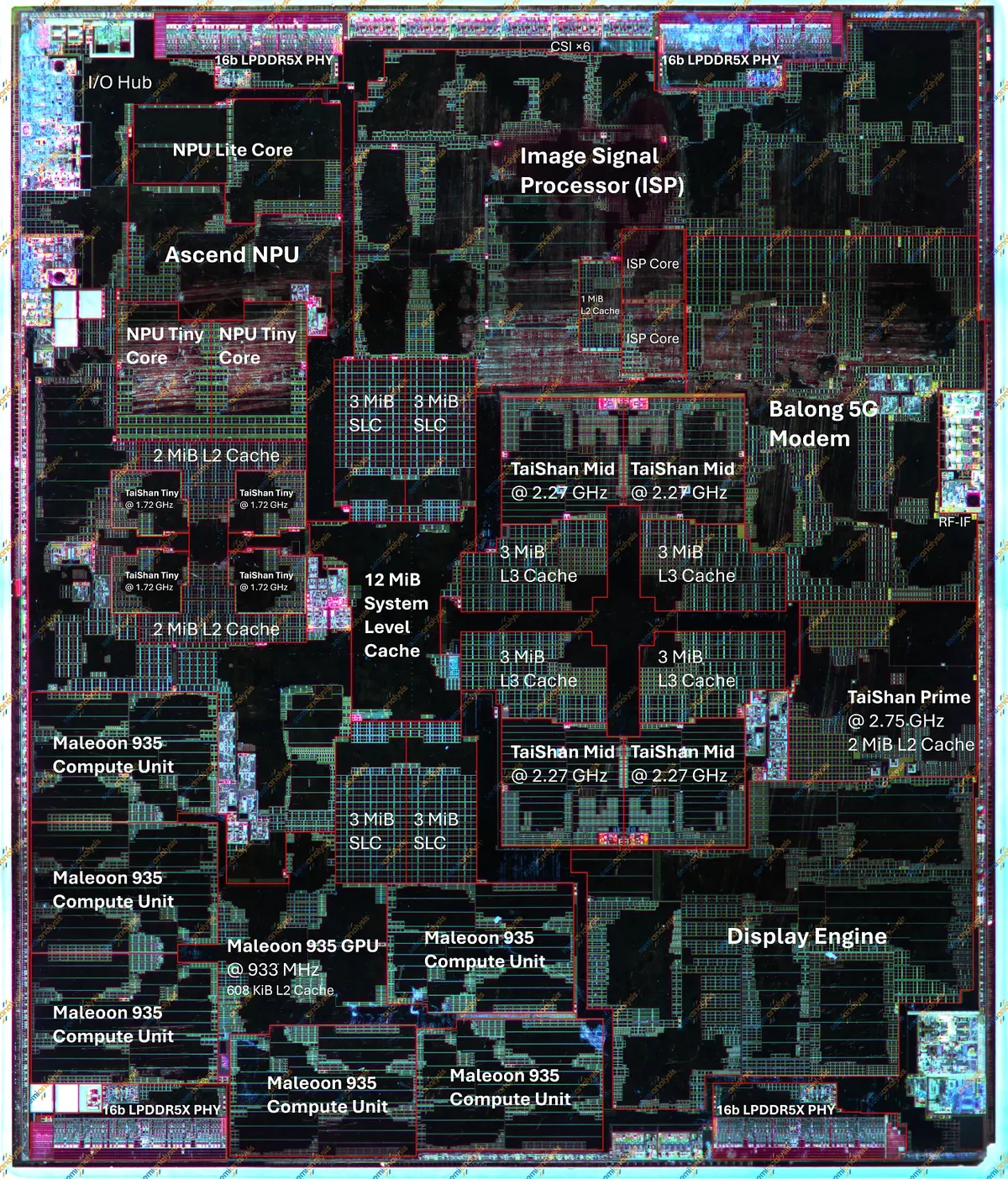
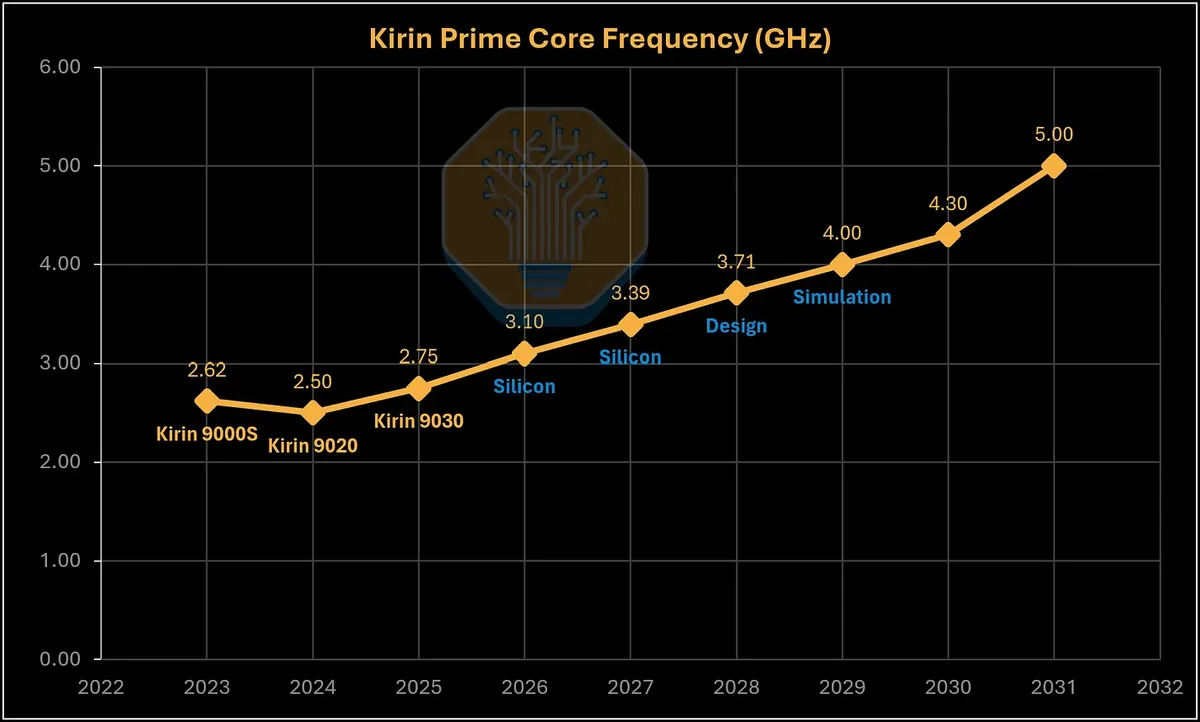
Each of those workarounds obviously adds complexity and cost, with N+3’s ceiling ultimately showing a huge trade-off. The Kirin 9030 Pro's prime core runs at 2.75 GHz and lands near Arm's 2021-era Cortex-X2 per clock, leaving the chip roughly level with Android flagships from three years ago and behind current parts from Apple, Qualcomm, MediaTek, and Samsung. Huawei’s roadmap does say that it’s targeting 5 GHz by 2031, but, as SemiAnalysis notes, that’s “far beyond what planar scaling alone could deliver.”
SemiAnalysis said it spent the past 18 months building the lab and has already earned revenue analyzing datacenter silicon. “We have already generated revenue on advanced datacenter chip teardowns, including our recent reverse engineering of a major TSMC customer’s COUPE CPO optical engine + EIC 3D stack.”
The company is taking aim at the Ottawa-based TechInsights, which is backed by private equity and held by the likes of Oakley Capital and CVC Growth. SemiAnalysis claims its rival is up for sale and has underinvested in equipment as a result, though that hasn’t been officially confirmed. The teardown also found the Kirin 9030 Pro carrying Samsung LPDDR5X memory, with 16 GB variants turning up DRAM from Chinese maker CXMT as well.
Get Tom's Hardware's best news and in-depth reviews, straight to your inbox.

Follow Tom's Hardware on Google News, or add us as a preferred source, to get our latest news, analysis, & reviews in your feeds.

Luke James is a freelance writer and journalist. Although his background is in legal, he has a personal interest in all things tech, especially hardware and microelectronics, and anything regulatory.
-
unsnap 'Reverse engineering' it's alright to steal IP on the hardware side, but if anyone tried that with software, ohhhh!Reply -
hotaru251 Reply
not true as there is a reason Pokemon Infinite Fusions and other fan pokemon games are allowed to exist and not attacked by nintendo lawyers.unsnap said:but if anyone tried that with software
they reverse engineer the stuff and then remake it entirely differently which is legal. You get a product that looks similar on output but is entirely different under the hood.
Most companies will do this. (its even 1 of reasons Noctua's 3d printable fans lack some details because they know people would do it) -
IntelUser2000 32.5nm pitch offers 10%^2 scaling over 36nm.Reply
Intel has said doing this buys roughly 10% higher density and looser front-side pitches, which is how a node built on GAA RibbonFET transistors and backside power can ship a wider local pitch than a DUV Chinese process and maintain a wide overall lead. SMIC reached 32.5nm without EUV lithography, leaning on DUV tools and quadruple-patterning that needs extra masking and etch passes
Which means the above conclusion is false, and typical of tech journalists that don't know the article's content.
There's no way PowerVia, which offers just 10% gain can have 38% advantages when the pitch alone should favor SMIC's process by 10%(1.2x for pitch vs 10% for PowerVia). The rest of the advantages are that Intel knows much better about optimization than SMIC does, so in reality they have a huge density advantage.
Intel 7 has 80MT/mm2 density. That's not so far off from 110MT/mm2 for SMIC. Intel 4 is 120MT/mm2. Intel 3 is roughly 130MT/mm2 for HD variant as it's nearly identical to Intel 4, and it's essentially Intel 4 HD. 18A is further 30% dense.
When the article says "38% behind", it means SMIC is 0.62x the density of Intel's 18A. Meaning 18A is 60% dense. The phrase "38% behind is misleading". Because if you take it to the extreme, you could say 99% behind, when in reality it means one is 100x the size. It would be more accurate to say 18A is 60% more dense.
Intel's 18A is far, far ahead of SMIC in density, and likely performance too. 60% used to be less than one generation, but the generation after that, the 14A is only offering 30% from 18A, so it would need multiple generations just for SMIC to catch up to Intel. -
Pierce2623 Of course their core iffers similar per clock performance to the X2. It’s basically an x2 copy ported to SMIC (TSMC and Samsung were the only nodes that ARM “qualified for the X2). When the 7nm SMIC manufactured chips initially made the rounds, people who follow ARM development ( I‘m basically talking about cellphone emulation nerds and ARM based handheld emulation nerds) were well aware of that. In fact most believed ARM basically sold them the necessary IP to make a “custom” core that was virtually indistinguishable from an X2 because ARM’s core architecture IP simply isn’t covered by US export controls like process nodes are but ARM didn’t want it called an X2 when the available nodes in China meant that it simply wouldn’t have comparable raw performance to an X2.Reply -
S58_is_the_goat Reply
Don't question it, just read it!IntelUser2000 said:32.5nm pitch offers 10%^2 scaling over 36nm.
Which means the above conclusion is false, and typical of tech journalists that don't know the article's content.
There's no way PowerVia, which offers just 10% gain can have 38% advantages when the pitch alone should favor SMIC's process by 10%(1.2x for pitch vs 10% for PowerVia). The rest of the advantages are that Intel knows much better about optimization than SMIC does, so in reality they have a huge density advantage.
Intel 7 has 80MT/mm2 density. That's not so far off from 110MT/mm2 for SMIC. Intel 4 is 120MT/mm2. Intel 3 is roughly 130MT/mm2 for HD variant as it's nearly identical to Intel 4, and it's essentially Intel 4 HD. 18A is further 30% dense.
When the article says "38% behind", it means SMIC is 0.62x the density of Intel's 18A. Meaning 18A is 60% dense. The phrase "38% behind is misleading". Because if you take it to the extreme, you could say 99% behind, when in reality it means one is 100x the size. It would be more accurate to say 18A is 60% more dense.
Intel's 18A is far, far ahead of SMIC in density, and likely performance too. 60% used to be less than one generation, but the generation after that, the 14A is only offering 30% from 18A, so it would need multiple generations just for SMIC to catch up to Intel. -
_Shatta_AD_ I’m pretty sure using quad-patterning induced a heavy density penalty as well if they want to keep yield in check. Feature details must be gapped accordingly to ensure ultra-minuscule misalignments doesn’t ruin the entire chip.Reply
Single patterning with EUV afford much better tolerances and chip designers can take way more risk with dense features. -
NinoPino Reply
In reality, the SemiAnalysis article says that is SMIC to have done a lot of optimizations to his SMIC 7 that "Even without EUV, SMIC has achieved density beyond TSMC’s mature N6 node which utilizes EUV" (Source : SemiAnalysis).IntelUser2000 said:32.5nm pitch offers 10%^2 scaling over 36nm.
Which means the above conclusion is false, and typical of tech journalists that don't know the article's content.
There's no way PowerVia, which offers just 10% gain can have 38% advantages when the pitch alone should favor SMIC's process by 10%(1.2x for pitch vs 10% for PowerVia). The rest of the advantages are that Intel knows much better about optimization than SMIC does, so in reality they have a huge density advantage.
Not true, it is so far. SMIC 7 (N+3), at 113 MT is a lot closer to Intel 4.IntelUser2000 said:
Intel 7 has 80MT/mm2 density. That's not so far off from 110MT/mm2 for SMIC. Intel 4 is 120MT/mm2.
No. It is not misleading. Is arithmetic.IntelUser2000 said:Intel 3 is roughly 130MT/mm2 for HD variant as it's nearly identical to Intel 4, and it's essentially Intel 4 HD. 18A is further 30% dense.
When the article says "38% behind", it means SMIC is 0.62x the density of Intel's 18A. Meaning 18A is 60% dense. The phrase "38% behind is misleading".
"SMIC N+3 is ~114 MTr/mm², 38% less than Intel 18A’s HD library" (Source SemiAnalisys).
You can directly write to SemiAnalisys and say that their article is misleading.
As you wish. Also pigs can fly without gravity.IntelUser2000 said:Because if you take it to the extreme, you could say 99% behind, when in reality it means one is 100x the size. It would be more accurate to say 18A is 60% more dense. -
usertests https://www.reuters.com/world/china/us-tells-asml-it-is-concerned-china-may-have-top-chip-tool-bloomberg-news-2026-06-19/ReplyU.S. Commerce Secretary Howard Lutnick has told ASML that Washington is concerned that one of its top chipmaking machines may have found its way to China in violation of U.S.-led export restrictions, Bloomberg News reported on Thursday.
It's over -
IntelUser2000 Reply
That's what you think is truth, then feel free to believe it. Also Dogs can talk, everyone knows this, only you don't.NinoPino said:As you wish. Also pigs can fly without gravity.
38% less, is 1.6x density. Basic arithmetic is hard for 99% of people I know.